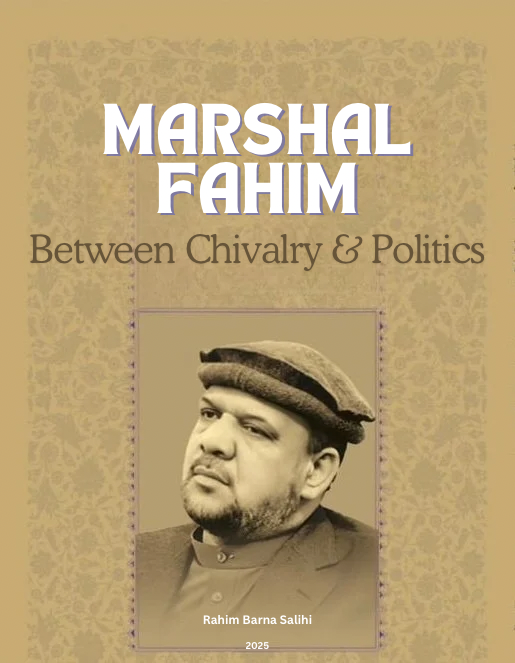
Marshal Fahim: Between Chivarly & Politics
 |
Name: Marshal Fahim: Between Chivarly & PoliticsAuthor: Barna Salihi
Published: 2025 |
| Download PDF Version |
Read the full text here:
About the Author
The author, Rahim Barna Salihi, is an Afghan political activist, writer, and witness to the country’s turbulent decades of war and state-building. Having lived and worked in close proximity to leading figures of the Jihad, the Resistance, and the post-2001 political order, he combines personal observation with critical reflection. His professional background includes service in governmental roles as well as active participation in cultural and political movements, which informs the dual perspective of insider and analyst that characterizes his writings.
In Marshal Fahim: Between Chivalry and Politics (مارشال فهیم؛ از عیاری تا سیاستورزی), Salihi presents a memoir-based study of Marshal Mohammad Qasim Fahim, the late Vice President of Afghanistan and one of the most influential commanders of the resistance against the Taliban. Drawing on first-hand encounters, oral accounts, and documented events, the book explores both the public career and the personal character of Fahim. It highlights the interplay between his traditional ayari (chivalrous conduct) and his pragmatic role in the politics of the Afghan state during a period of profound transformation.
This work stands at the intersection of memory and analysis, offering readers not only a portrait of one man but also a reflection on the dilemmas of Afghan politics in the early twenty-first century. This an English translation of the original persian book published in Spring of 2025.
Between Chivalry & Politics
It has been said that the purpose of knowledge is to understand things, people, and phenomena correctly—and above all, to understand human beings. In our own religious teachings, the knowledge of the self is considered a step before the knowledge of God. Truly understanding a person, however, is no easy task. It requires deep reflection. As Alexis Carrel once wrote, “Man is the unknown.”
It is with this understanding that I write about the life and legacy of Marshal Fahim, one of the most influential figures in Afghanistan’s last four decades of history. I do so in a context where, especially in Afghanistan, the remembrance of great figures is rarely accompanied by an honest reckoning with who they truly were. Excessive devotion from followers and bitter hostility from critics both make it difficult to uncover the realities hidden in a leader’s personality and deeds.
In these pages, I will explore both the strengths and weaknesses of Marshal Fahim as I came to know them over thirteen years of personal and public life alongside him. I believe this effort is not only a unique contribution to understanding Fahim, but also a useful resource for those who seek inspiration from the lives of great political figures as they step into the arenas of struggle and politics themselves.
We must remember: when we speak of a “personality,” we are speaking of an exception. It does not matter whether in politics, the military, science, culture, or art—there are certain innate or acquired qualities that set a true personality apart from the ordinary. To become a personality, even a negative one, is no simple matter. History rarely shows us individuals who became so merely by accident.
Among the influential personalities of Afghanistan in the past half century, Marshal Fahim stands prominently. Though little time has passed since his death, he, like all notable figures, is viewed through different and sometimes conflicting perspectives. As a student of politics, as an active participant in our country’s political life, and as someone who owed much to him, I cannot remain indifferent. I feel it is my duty to bring forward the truths of his time and the untold aspects of his personality and legacy.
Normally, understanding a person begins with their family, their work, and their education. Studying the culture and social environment around them further reveals their worldview and thinking. And their presence in society—their successes, their failures—shows clearly the results of their actions. In this book, I use the same approach to address the questions of critics and readers alike: What were Marshal Fahim’s strengths? What were his weaknesses? What do they reveal about his character and his work?
It must be said that this work is not a collection of secondhand stories. It is based on my own direct experiences. For that reason, it contains no references to other sources.
This book is presented in five chapters:
- Chapter One: The Period of Jihad (Dauran-e-Jihad)
- Chapter Two: The Islamic State Years (Dawrah-ye Dawlat-e Islami)
- Chapter Three: The Time of Resistance (Dauran-e Moqawemat)
- Chapter Four: After Massoud (Pas az Massoud)
- Chapter Five: Another Dimension of Marshal Fahim’s Personality (Janib-e Digar-e Shakhsiyat-e Marshal Fahim)
The first two chapters are brief, while the later chapters are more detailed, since they draw directly on my own memories during times when I was close to the heart of decision-making.
It is worth noting that I began writing this book in the third year after Marshal Fahim’s passing. For various reasons, publishing it was not possible then. Now, in a time very different from those years, with even the smallest opportunity available, I am finally able to bring it to readers.
I hope that the study of this work will shed some light on the transformations of Afghanistan during the past half century.
Chapter One: The Period of Jihad
Dauran-e-Jihad
In the early years of the jihad (the 1980s, or 1360s in the Afghan calendar), I was still a primary school student. During those days, the mujahideen of Panjshir would flow northward, first toward the province of Takhar. One of their bases of residence and command was in our own district of Warsaj, where we lived.
Our family originally came from the village of Dasht-e Riyut in Hesa-ye Awwal Panjshir. But in 1984 (1363 AH-Sh), under the heavy pressure of Soviet military offensives in Panjshir, we were forced to leave. We migrated to Warsaj, in the northeast of Takhar, bordering the district of Paryan in Panjshir. At that time, Taloqan—the provincial capital of Takhar—had not yet been liberated by the mujahideen. Warsaj was one of the few districts in Takhar under their control.
The story of our migration—leaving Panjshir through Khawak, passing through Andarab and Khust, and finally reaching Taloqan—was filled with hardship. It mirrored the bitter experience of nearly all Panjshiris, who were exposed to the heaviest Soviet assaults on their villages and valleys. Compared to many families, perhaps my own suffered a little less, due to my father’s standing in society and our relatively stable economic situation. Yet, looking back now, even that “lesser suffering” was heavy and exhausting beyond measure.
After six months in Taloqan, we moved to Warsaj, where we remained for eight years. I remember precisely the day we left Panjshir: the 15th of Hamal, 1363 (April 1984). By then, within a year or two, the Panjshir front had already expanded its area of operations beyond Panjshir itself—first into Andarab and Khust, and later to Warsaj and Farkhar.
The jihad years were a time of constant movement—families, mujahideen, and traders all moving back and forth within territories controlled by the resistance. Among the many fighters and guests who frequently visited our home, my father had especially close friendships with three of Massoud’s companions: Fahim Khan (later known as Marshal Fahim, commander Panah, one of Massoud’s most brilliant commanders, who was martyred in Paghman in the final years of the mujahideen government, while fighting the Taliban, Zabit Saleh (Saleh Mohammad Registani), a soldier, writer, and one of Massoud’s closest allies, who later held senior government positions and eventually became a representative of Panjshir in the 15th Wolesi Jirga (National Assembly).
Of that group, today my father and Mr. Registani are still alive, and the same bond of friendship and affection remains unbroken.
In those years, under the rules laid down by the leadership of Shura-ye Nazar (Supervisory Council), many things were prohibited in the areas under Ahmad Shah Massoud’s command. Listening to music, shaving one’s beard, and other such matters were banned. Yet I sometimes noticed that certain well-known figures within the front, though never in public, did not always abide strictly by these regulations. Perhaps it was out of necessity, perhaps out of human weakness, or maybe out of the kind of straightforwardness that Hafez once called rendi o biriyayi—a guileless nonconformity. Marshal Fahim was among those who did not show much severity on such matters.
I remember one day in our house, when Marshal Fahim was present, local music was being played—songs of Mian Ahmad Agha, the famous folk singer of Panjshir. He did not forbid it. For me, as a child, this was puzzling. When I asked my father about it, he told me: “Fahim Khan has studied up to Mishkat al-Sharif, and his father himself is a religious scholar.” In this way, my father wanted to ease my doubts, to explain that these things were not the ultimate measure of good and bad in a person, and that such prohibitions were not permanent.
Children in the schools and madrasas of the jihad were often raised with ideology. Their role models were religious and jihadi ideologues. They were sensitive, passionate, and often saw the world through a single lens. Only with time, with broader study, and through exposure to different gatherings and environments, did their minds begin to soften and their perspectives widen.
From the very beginning, I saw in Marshal Fahim certain qualities that set him apart from others. Unlike many of his comrades, he remained consistent with these traits throughout his life. For others, I later realized, much of their strictness and piety had been born of circumstance and necessity; over time, many abandoned it. But Marshal Fahim carried something unique to the end: a certain ayari—a code of honor, generosity, and straightforwardness—which he preserved until his final days.
It is better to understand Marshal Fahim from this starting point: though he came from a religious family, with a father who was a scholar, and though he himself had studied Islamic texts, he was never a harsh or narrow-minded man. Even after the fall of Taloqan to the Taliban in 2000 (1379), when I was by his side in both travel and residence until his death, he never hid his love for poetry, for listening to local music, or for organizing traditional sports such as buzkashi. At the same time, he was never seen engaging in acts contrary to faith or morality—never in sins considered grave. Whatever he was, he showed himself plainly. He was no hypocrite.
The influence of his family, his society, his education, and his years in the jihad remained with him until the end. He was religious, generous, loyal to family ties, sociable, fond of noble traditions, and committed to promises. Even at the height of his power, he remained humble and accessible.
In all my life, I have met few men whose personality carried as much weight and sincerity as Marshal Fahim’s. If there was one fault in his conduct toward family, relatives, subordinates, friends, and people, it was his excess of forgiveness and leniency.
Marshal Fahim could rightly be called a reflection of Afghanistan’s social ethics and local culture. There was hardly anyone, in any sphere of Afghan cultural or social life, who did not feel some connection to him or who did not, in some way, benefit from his presence.
With scholars and students of religion, he maintained bonds and supported madrasas. With poets and writers, he had another kind of relationship. With elders and influential figures, he engaged as he saw fit. With politicians and even with ordinary people he had once known, he always maintained his ties. And with the general public, whenever there was a need for cooperation, he never withheld his hand.
There is no doubt, among those who knew him, about his qualities of generosity, tolerance, patience, and magnanimity. And I, who was close to him, can attest with many examples.
In addition to these personal traits, Marshal Fahim was counted among the learned men of the jihad. In its early days, he served as the head of the Committee for Preaching and Jihad in Panjshir. At the same time, he was often a member or the head of delegations sent by Ahmad Shah Massoud to places outside Panjshir.
I remember well the years 1984–85 (1363–64 AH-Sh). At that time, Ahmad Shah Massoud had not yet arrived in the districts of Farkhar and Warsaj. It was Marshal Fahim, along with Abdul Naser Formul—one of the respected mujahideen from Andarab, close to Massoud, who years later would be mysteriously assassinated during the first fall of Taloqan to the Taliban—who came to Farkhar to prepare the ground for Massoud’s arrival.
My father was invited to accompany them. On his return, he told us how, in a gathering of commanders and elders in the village of Voruk in Farkhar, Fahim Khan gave a speech the likes of which he had never expected from him. Fahim spoke with authority and depth, tracing his own struggle back to before the revolution itself.
Fahim’s early years of jihad had begun in the late 1970s (1357–58 AH-Sh) in Kunar and Nuristan, where he fought alongside the mujahideen of Hezb-e Islami under Gulbuddin Hekmatyar. After meeting Ahmad Shah Massoud, he came to Panjshir and remained by Massoud’s side until the end of his life.
In the later years of the jihad, especially as Kabul neared liberation, Fahim was tasked with important political missions by Shura-ye Nazar. He traveled from Kayan and Pul-e Khumri to Hairatan, Faryab, and other parts of northern and eastern Afghanistan, working to win over groups that still supported the Kabul regime. At one point, he worked closely with Dr. Abdul Rahman, the deputy head of Shura-ye Nazar from Nuristan, who later became Minister of Aviation in the mujahideen government, but was killed during the early Karzai period in Kabul airport amid a protest of pilgrims. Together, they built networks and maintained communications inside Kabul itself.
My father told me another story: at one meeting in Kayan, in the home of Sayyed Mansur Naderi—the leader of Afghanistan’s Ismaili community, head of his own political party, and later a parliamentary representative for Baghlan—Dr. Najib, the President at the time, personally called Naderi. He said: “I have heard that someone named Fahim, from Ahmad Shah Massoud’s group, has come to your area.” Naderi replied, “Yes, we too have heard, and we are trying to locate him and capture him.” In reality, Marshal Fahim was staying in Naderi’s house itself, working to organize joint plans. And while Najib was asking for vigilance, Naderi was assuring him: “Do not worry, there is nothing of concern.”
From this it was clear: Najib himself kept close watch on Fahim’s activities, considering him one of Massoud’s most important men.
Of course, the most debated part of Fahim’s legacy lies not in those years of jihad, but in his political behavior after the mujahideen’s victory, during the Islamic State period, in the time of resistance, and later at the Bonn Conference. Those chapters will come in their time. During the jihad itself—whether inside Panjshir or beyond it—no one had a criticism of him.
Even once, when he was sent as a representative of the front to Pakistan, together with Dr. Sayed Hussain Shaheed—one of the prominent commanders of Takhar, who later was martyred in Tangi Farkhar by an ambush from Hezb-e Islami—he carried out his mission flawlessly. This was in the late 1980s (around 1368 AH-Sh). After completing the assignment and earning the satisfaction of Jamiat’s leadership in Peshawar and of the front’s commanders inside Afghanistan, he returned with honor.
The criticisms that exist of Marshal Fahim—and indeed, such criticisms must exist—belong to a later time, when he assumed leadership of the front after Massoud, or when he held high state office. This is natural, for the standard by which a politician is judged is always relative to the authority and responsibility he holds. The greater his power, the greater the expectations, and thus the sharper the criticisms.
In the past half century of Afghanistan’s history, not a single political leader has lived free of such criticisms. Even those few figures remembered today with respect and admiration were not celebrated to the same extent during their lifetimes, nor by all communities. In a society repeatedly shaken by political and military upheaval, often under the shadow of foreign intervention, this is inevitable. But that does not mean all criticisms were unfounded or motivated only by malice. Many were real, rooted in the expectations and disappointments of a wounded nation.
Chapter Two: The Islamic State Years
(1371–1375 AH-Sh / 1992–1996 CE) (Dawrah-ye Dawlat-e Islami)
Until the martyrdom of Ahmad Shah Massoud, Fahim could not be considered an entirely independent actor with full authority. The key decisions rested with Massoud himself. Yet, Fahim’s role as advisor and deputy was never insignificant—whether during the jihad, the years of the Islamic State in Kabul, or the resistance against the Taliban. In all of these stages, his counsel was crucial in major political decisions. Of course, not being an “independent player” does not mean he lacked his own perspective and outlook on power and politics.
During the Islamic State of Afghanistan, led by Professor Burhanuddin Rabbani between 1992 and 1996 (1371–1375 AH-Sh), Marshal Fahim was, after Rabbani and Massoud, the third most important figure in the country’s decision-making. This was the period that many describe as the years of “civil war” or tanzimi conflict. For those in power, however, it was seen as the defense of the Islamic State’s legitimacy. The government’s primary task became the defense of Kabul against the assaults of three forces: Hezb-e Islami under Gulbuddin Hekmatyar, Junbish-e Melli under Abdul Rashid Dostum, and Hezb-e Wahdat under Abdul Ali Mazari—each backed respectively by Pakistan, Turkey, and Iran.
At that time, Fahim held the rank of Estar General (Lieutenant General) and served as Director of National Security. In this capacity, he played a central role in defending Kabul while also handling political and civilian matters.
In 1994 (1373 AH-Sh), I graduated from Abu Osman Taloqani High School in Takhar and hoped to pursue studies abroad. It was said that some students would be sent to Egypt, and I wanted to be among them. For this, I could think of no better person to turn to than Marshal Fahim.
Though he was not easy to find in those days of constant war and turmoil, especially for a young student and stranger in Kabul like myself, whenever I crossed paths with him—even by chance—I benefited from his generosity and brotherly kindness. I will never forget one winter morning in Karteh Parwan. The sun had not yet risen, and I, together with my friend Abdul Mateen Farhang, who was also a newcomer to Kabul, went to Marshal Fahim’s residence. The night before, the city had been pounded by rockets. Even near his house, the marks of explosions were visible. When we arrived, his guards were preparing to head to the front lines. Soon, there was the roar of vehicles and the rush of bodyguards. We stood quietly at a distance, near the gate from which the Minister of Security was to emerge.
Fahim came out, a child clinging to his legs. As soon as his eyes fell on me, he slowed his steps, called me closer, reassured me about his intention to send me abroad for studies, and asked where I was living. When I told him I had no fixed place, he immediately handed me some cash and wrote me a note for the guesthouse of the National Security service, where I stayed until my work was settled.
This was not just my experience. Hundreds, even thousands of others, who came to him in those chaotic days found their needs met, or at the very least, their hearts reassured. He never forgot the code of honor and camaraderie that defined him.
During this period, Fahim often acted as caretaker President in the absence of Rabbani, and sometimes, even in Massoud’s presence, he was the chief commander for the defense of Kabul. Yet he still found time to meet friends, organize buzkashi matches, and enjoy life’s simple gatherings.
We must remember that the five years of mujahideen rule in Kabul were like a prolonged emergency. The government’s main occupation was defending the capital. Other areas of governance were sidelined, and this led to a kind of disorder in society, where individuals and groups misused the names of powerful leaders like Rabbani, Fahim, and even Massoud to pursue their own interests.
Even today, more than two and a half decades later, similar accusations are leveled at the leaders of the anti-Taliban resistance. At times, such criticism in Afghanistan has been more rooted in rumor than in fact. But another reason for these accusations was the absence of a unified government and the reality that the Islamic State never controlled the whole country. Responsibility was often scattered, and the government—already overwhelmed—struggled to supervise all factions.
This pained Massoud deeply. He knew that confronting these abuses risked alienating commanders and leaders, which could destabilize the fragile alliance. Yet, it is undeniable that one of the major causes of Kabul’s double collapses to the Taliban was precisely this corruption, nepotism, and factionalism within the Afghan governments of the time.
In any case, the five years of the Islamic State, which Marshal Fahim sometimes referred to as the “monarchy period,” were a turning point in his political life. Despite war and crisis, it was a valuable opportunity for him to grow into a recognized political and military leader.
Fahim often acknowledged that his success in this period was indebted to two of Panjshir’s great commanders: Gada Mohammad Khalid and Commander Panah. Both names carried immense weight in the struggle alongside Massoud, to the point that even Sheikh Abdullah Azzam, the Arab ideologue, spoke admiringly of their courage.
Marshal Fahim often recalled a large gathering of commanders and politicians in which Ahmad Shah Massoud himself was present. The discussion centered on choosing someone who could manage both security and defense alongside Massoud. At that time, many of the elders of the State and the Front wanted Massoud to be free to focus more fully on political and national matters. Several names were proposed, but Commander Gada, despite Fahim’s humility, insisted: “There is no one more suitable than you.” The others, in agreement, raised their hands in prayer and affirmation.
According to Fahim, Commander Panah—who had never failed to stand by him in any battle—redoubled his commitment in those years, working with him even more seriously in the mission of defending Kabul.
It was in this period that the name “General Fahim, Head of National Security” spread widely. He commanded a vast sphere of authority in both military and security affairs, controlled much of the resources and finances, and distributed them as needed. Most importantly, in looking after the welfare of his comrades from the days of jihad, his name carried great respect and trust. (Later in this memoir, with the help of several anecdotes, I will return in more detail to this particular aspect of his character.)
When the Taliban entered Kabul on the 28th of Mizan 1375 (October 1996), Marshal Fahim was the last senior government official to leave the city. On Massoud’s instruction, he went to see Dr. Najibullah, who had sought refuge in the UN compound, and urged him to come with them to Panjshir for his own safety. Fahim assured him that if he wished to leave the country later, no obstacle would be placed in his way, and that even in the worst case, he would have their protection. But Najib refused.
Fahim would often recount how, during the mujahideen’s rule, he had visited Dr. Najib many times in the UN office, spending hours discussing various matters. In that last meeting, acting both as a statesman and in the spirit of ayari (honor and loyalty), he pleaded with Najib to leave Kabul with them. Yet Najib chose to stay behind.
With the Taliban’s advance—and with countless internal challenges weakening the capital—the mujahideen were forced to retreat from Kabul and many other regions. Yet for the next five years, they maintained control over roughly five percent of Afghan territory, centered in Panjshir, and crucially, they retained international recognition as the legitimate government of Afghanistan.
Chapter Three: The Resistance Period
(1375–1380 AH-Sh / 1996–2001 CE) (Dauran-e Moqawemat)
This chapter in Afghanistan’s history was a matter of life and death for the movement and its people. After five years of ruling in the capital and five years of fierce defense of the Islamic State, they were now confined to barely five percent of the country’s territory—fighting not just for survival, but to ensure that the flag of their state would not fall.
In this period too, after the supreme commander of the resistance, the name most often heard was Marshal Fahim’s. The resources of earlier times were gone, there was no fixed headquarters, and circumstances shifted by the hour. Yet up until Massoud’s martyrdom and the eventual collapse of the Taliban, Fahim’s central base of command was in Takhar, though he appeared wherever the need arose—whether in Shamali, Baghlan, or elsewhere in the north.
Less than a year after Kabul’s fall to the Taliban, Fahim traveled to Takhar. From there he took along several of his friends, including my father (Haji Salih), and set out for Kunduz, which at that time was still beyond Taliban control. I accompanied my father on that journey.
That day, Marshal Fahim took lunch at the house of Mirza Naseri, a prominent Pashtun commander and influential figure in Kunduz. Nearly all of Kunduz’s jihadi commanders from various factions gathered there. Though the national situation was grim, Kunduz seemed to stand on the edge of surrender. In time, when the fighting grew harsher, many of those very commanders—including Naseri himself—would switch allegiance to the Taliban.
After the meal, Fahim and his entourage—including Haji Akram Khan, the provincial intelligence chief of Takhar and a respected commander; General Zahir Aghbar, who had served in the mujahideen government and would later hold senior diplomatic posts in Germany and Tajikistan; and many other commanders, elders, and even horsemen from Kunduz—set out for Imam Sahib district in northern Kunduz.
The convoy of cars was long, and before it could exit the city, it was blocked by a group of protesters, some of them armed. The protest was ostensibly over a local killing incident, but it was also clear that some wanted to use the occasion to disrupt Fahim’s program and damage his reputation. With patience and restraint, Fahim defused the situation, and the convoy moved on.
In Imam Sahib, Fahim met with many people. Some assumed his visit was for leisure or entertainment. That night, as a guest at the home of Commander Latif—an influential jihadi of Imam Sahib who later served as governor of Kunduz, Takhar, and Samangan under Karzai and Ashraf Ghani—Fahim first thanked him for the welcome, then spoke about the beauty of Imam Sahib, Latif Khan’s residence, and the famous horses and horsemen of the region.
As the night deepened, he confided his true purpose: “My visit is not official, nor has anyone asked me to do this. But I believe if we leave everything in the hands of politicians, nothing will come of it. I want us to form a proper army—before the Taliban cross the Salang Pass, let us show them what unity looks like among the honorable people of the Qataghan.”
In northern Afghanistan, traditions and cultural codes among elders and common folk held great weight. Any political or military move that ignored these norms was bound to face obstacles. Fahim understood this, and often entered into discussions with local leaders through this cultural doorway. On this journey too, although his mission was political, he cloaked it in the appearance of camaraderie and friendship.
Later events—and the memoirs of figures like General Abdul Malik—revealed that men like Dostum, Mohaqiq, and Sayyed Mansur Naderi were already engaged in negotiations with the Taliban, with Pakistan as mediator.
Indeed, during this very trip, while guests were taken to fish along the Amu River and a feast was laid for them in the forest, two helicopters suddenly appeared overhead. They belonged to General Dostum. The display, arranged by Abdul Rauf Ibrahimi (Latif Khan’s brother, then known as Haji Rauf), was meant to show Dostum’s influence and his own importance in those regions. (Ibrahimi would later, by political compromise, become Speaker of Parliament, holding the post for years beyond the legal term due to delays in elections.)
Fahim did not like the show of power. After the helicopters circled a second time, he told one of his guards: “If they come again, fire a rocket at them.” The flights stopped immediately, for it was clear the maneuver had been coordinated with the hosts on the ground.
I recall this episode to illustrate how difficult and complicated the circumstances were in those days.
When a government, after five years of war, constant accusations of corruption, and the loss of its capital, tried to rebuild and rally its people again, the task was almost impossible. Yet Fahim sought to wrap those complexities in the cloth of friendship—turning political missions into gatherings that looked like leisure.
The next morning, he took his companions to meet “Salar Malang,” a local eccentric who, it was said, had sat in the same place for twenty-seven years, to the point that a shop had been built over his head. Visitors to Imam Sahib always sought him out. Malang spoke strangely, and when he saw Fahim, he told him: “You’ve received—now give to others as well.” The remark became a joke among the group, each teasing Fahim with requests. But Fahim laughed and said: “I understood his meaning. He reminded me to share whatever I receive—not to keep it for myself or for just a few, but to spread it among all my comrades.” From there, he spoke about the value of warm friendships compared to the cold discipline of party politics, something he never had much affection for.
Marshal Fahim’s personality always gave greater weight to ayari (honor), friendship, and loyalty in his dealings. He valued camaraderie over rigid organizational rules.
At that time, despite the plans and efforts of Massoud and his closest allies, everyone felt they were in the calm before the storm— Massoud himself knewwell he stood directly in its path. He relied on his closest allies like Fahim and a handful of others to manage the imminent collapse in the north, ensuring that everything would not be lost at once.
Events unfolded quickly. The war spread to the northern provinces, and many regions raised the white flag to the Taliban even before they arrived. Just before the final fall of Taloqan in the autumn of 2000, after forty-five days of fierce battle, Fahim carried out a mission that many considered miraculous—halting a Taliban advance through Andarab toward Khawak and Panjshir, inflicting heavy losses and delaying their progress at a critical moment.
After the final fall of Taloqan, the Resistance Front regrouped in four directions around the city. The main headquarters was established beyond the Kokcha River, in Khwaja Bahauddin, which became the central base of the resistance leadership. The second was in Farkhar to the east of Taloqan, which became Marshal Fahim’s own command post, while additional positions were set in Kalafgan to the northeast and Chaal district to the south.
Barely two or three days after the forty-five-day battle had ended, I joined the Resistance as Marshal Fahim’s assistant, reporting to his base in the Karani area of Farkhar. This was the realization of a long desire. Since the fall of Kabul four years earlier, I, like thousands of other students, had been cut off from education. I had always hoped for meaningful work in government or the front, but it had never been possible. This time, before I even spoke, Fahim himself asked me to join him in clerical work.
I had fled Taloqan with my uncle and went with him to the house of Haji Kateb, a cousin of Fahim, where the Marshal’s command was based in the home of Commander Makhdoom Abdullah in western Farkhar. On our return, as we prepared to go to Warsaj where our families had taken refuge, Fahim’s car stopped near us. One of his guards, Rahmanuddin, called me over and said, “Our number one (reffering to his boss) will be waiting for you at eight tomorrow morning.”
The next day, when I arrived at the headquarters, Fahim was at breakfast with General Dawood Khan (Massoud’s aide in the jihad, later a key commander in Takhar and eventually martyred in a terrorist plot at the provincial governor’s compound), Mudir E’tabar (one of Massoud’s representatives in the northeast during Jihad, later head of Administrative Affairs in Karzai’s government and now a senior leader of Jamiat), Mawlawi Abdul Jabbar, and Commander Makhdoom Abdullah. When Fahim saw me, I could sense his delight.
The conversation that morning ranged across many topics until it turned to the prayer of istikharah. Fahim asked Mawlawi Abdul Jabbar about the supplication. The mawlawi admitted he always read it from a paper, and none of the others remembered it fully. I mentioned that I knew it by heart and recited it. At Fahim’s request, I then wrote it down for him on a slip of paper.
Soon after breakfast, Fahim rose and asked me to follow him. Across from the guest room was his private chamber, small and neat, rarely entered without permission. Inside, he said: “It is good you came. Yesterday, some of the men told me you wanted to go to Khwaja Bahauddin for study. You understand that right now conditions are not favorable for such things. I want you to work with me. By being part of the daily responsibilities, you will gain experience. Even without formal education, this will help you grow and strengthen your character.”
I accepted eagerly, asking only for two days to visit my family in Warsaj and collect my belongings. Pleased, he smiled and said, “Wait, let me send some money for your father. He may be struggling in these hard times.” He wrote a note, handed me some cash, and said, “Give my greetings to Haji (my father).” Two days later, I returned to a busier, more urgent atmosphere. Commanders and fighters were arriving constantly, and the pace of events had quickened.
As Fahim had promised, I soon learned the vast difference between reading books or writing essays and actually working in the field. I discovered how complex war and politics truly were—how much courage and wisdom they demanded. I saw firsthand the strengths and weaknesses of commanders and politicians. Though I never reached high government office, I gained immeasurable intellectual growth.
On the afternoon of 21 September 2000 (30 Sunbula 1379 AH-Sh), I entered Fahim’s base in Karani, just as he prepared to head to the front lines in Kalafgan where Commander Pir Muhammad Khaksaar and others had planned to retreat. That area, northeast of Taloqan, was critical: if defenses failed, the Taliban could march directly into Badakhshan. Kalafgan was rightly called “the gateway to Badakhshan.”
We set out from Karani toward Kalafgan despite the visible risk of ambush in the “Desht-e Robah” region, a sharp-angled pass where Taliban fire could easily target vehicles from surrounding heights. Fahim’s white Land Cruiser, followed by a Russian jeep, was easily recognizable from a distance. I sat in the front passenger seat, while Fahim and a bodyguard were in the back.
As we drove, Fahim asked me suddenly: “Do you write poetry?” I said yes. “Then recite one for me,” he insisted. I had recently composed a ghazal inspired by Bedil’s famous verse “The path to grandeur lies through humility,” and I happened to have it in my pocket. I read it aloud, and Fahim listened attentively, offering warm encouragement. In the middle of that grim, war-torn atmosphere, his appreciation for poetry astonished me. From then on, I often shared my verses with him first. To this day, I feel indebted to his encouragement.
Those early days were remarkable and unforgettable. Despite the exhaustion of forty-five days of brutal fighting in Taloqan, and despite the constant danger around us, Fahim still paid close attention to local matters. He asked Commander Makhdoom Abdullah about the number of Friday mosques in Farhar and began organizing a program to use them for public advocacy and mobilization.
He regularly explained to the people the political situation of the world, of Afghanistan, the reasons behind Pakistan’s interference, the fall of the mujahideen government in Kabul, the nature of the Taliban, and the necessity of resistance against them.
For me, this style of political explanation and civic mobilization was something new and refreshing—especially in those desperate years. It inspired admiration. Even then, I followed his words with deep attention, even though we were caught in between life and death situations. I noted down the most striking points of his speeches, later giving those notes to him for review, and finally recording them in my diary alongside my other memories. A few of my comrades, however, misunderstood my intent and thought of it differently.
One day, after I handed Marshal my notes and he returned them with comments, a companion sitting next to me in the back seat of the car—Haji Mullah Akbar—joked quietly: “Son of Haji, how far will this flattery get you?” I quickly replied: “These things are above your level. Best if you keep quiet.”
Alongside his mosque speeches, Marshal also arranged lengthy meetings with religious scholars and local leaders behind the front lines. If groups of journalists arrived in his territory, he explained the situation to them comprehensively. He also spoke via satellite with people abroad, asking about international political developments.
Despite suffering from diabetes since those years, for a military commander in wartime, he accomplished in civil and military arenas far more than was normally expected from a military commander of with his kind of responsibilities.
Marshal Fahim was especially gifted in delivering motivational speeches to ordinary people. He used verses from the Qur’an, sayings of the Prophet, poetry, and historical anecdotes, weaving them into powerful and positive rhetoric. On one such occasion, during the heat of the resistance, he spoke at the Grand Mosque of Taloqan in a way that transformed the perception that many among the youth and intellectuals had of him.
That because people knew Marshal Fahim simply as a commander, and later as a security minister. But gradually, he revealed the many other dimensions of his personality.
His problem, however, was that he often failed—or perhaps one should say, refused—to balance between his style of ayari (honor and camaraderie) and political strictness. He cared little for protocol, often failed to manage time strictly, and sometimes let poetry gatherings, sports, or casual gatherings delay more pressing affairs. I remember once, in the home of Salahuddin Khan, a notable of Farkhar and a close relative of Haji Akram Khan, as poetry was being recited and stories told, someone rushed in to report that several key front hills had fallen in the fighting. He warned that if they were not retaken, further advances by the enemy would follow. Marshal, after a short pause, replied: “From here to Spin Boldak, there are thousands of hills. If we lose our nerves over every one, we will get nowhere.” He often did not treat such reports with the same urgency as others, which both puzzled and, at times, frustrated his companions.
Yet what impressed me most in every circumstance was his extraordinary patience and his deep trust in God’s decree. These two qualities, combined, gave him a unique strength.
Let me share two examples:
First: Barely a month after establishing his base in Karani, Farkhar, the Taliban advanced and captured the high grounds of Shakh-e Palang, Tal-e Gorgan, and areas of Nahr-e Aab and Namak Aab, increasing the threat to Farkhar. On the day we were supposed to retreat east to Chaman-e Khosdeh, panic and confusion gripped everyone. People feared the Taliban would overrun us if we delayed departure. Yet Marshal, calm and unshaken, performed his ablutions, prayed with humility, signed off several notes and documents, and continued to work steadily, even as alarming reports came in over handheld radios. Only after everyone had left did he finally depart the base—last of all.
During those tense hours, Mudir E’tabar—one of Massoud’s representatives in the northeast—paced anxiously back and forth, clearly wishing Marshal would hurry. Finally, exasperated, referring to Marshal taking time to perform ablutions and offer prayers, E’tabar turned to us and muttered: “Is now really the time for all this?” We could only laugh bitterly.
Second: Tensions arose between General Dawood Khan and other commanders in Farkhar. Dawood felt that with Marshal Fahim present, his own authority was overshadowed, and his men might gradually drift away. Perhaps at his request, the resistance leadership decided to shift Marshal’s headquarters from Farkhar to Kishm after four or five months, leaving Dawood in charge of the local front lines. Marshal never once complained about this decision, nor even mentioned it, though it had been fueled by misinformation from a handful of commanders. Soon after, he returned to Farkhar and restored order, making those earlier malicious designs meaningless.
During the time when the town of Kishm in Badakhshan served as Marshal Fahim’s military headquarters, once a week he would personally go to the front lines in the mountains of Kalafgan, which bordered Taloqan to the east.
On one of those days, I was with him inside a rather fragile bunker in a place called Kapa Sang, together with several notable figures: Pir Mohammad Khaksar (a well-known jihadi commander from Takhar, later holding posts in the police and army, and today a senior member of General Dostum’s National Movement, belonging to the Uzbek community), Haji Agha Gul (a jihadi commander who also served as police chief and mayor of Taloqan during the Karzai era, and who was ultimately killed in an ambush by the Taliban in 2021 while defending Taloqan), Ahmad Faisal Beikzad (who later served as governor of Takhar, Faryab, and Badakhshan under Karzai and Ghani), Qadam Shah Shahim (later Chief of Army Staff of the Ministry of Defense and ambassador during the National Unity Government, originally from Badakhshan), Aziz Ghairat (police chief of Panjshir and Jowzjan during the Karzai government, and a close confidant of Marshal Fahim), and others.
While we were in there, suddenly, Taliban gunship helicopters swooped in at low altitude and began rocketing the surroundings of the bunker. Inside, the air was quickly filled with dust and smoke. Amid the chaos, Marshal Fahim, seated at the head of the gathering, continued to recite poetry calmly. Turning to his guard, he said: ïf wer are martyred, do not remove our bodies from here. Raise a flag over our grave and name us the uknown martyrs.” Fear and panic gripped everyone else, but he remained composed.
When the bombardment ended, it became clear that Haji Agha Gul was bleeding from his ears. In the confusion and dust, he had tried to step outside just as a rocket struck the bunker’s entrance. The blast damaged his eardrums. As he treated his injury, Marshal remarked with calm conviction: “Did I not tell you? Death with comrades would be a celebration of life. No one should have left this place.”
Life in Kishm, compared to Farkhar, was in some ways amicable. Geographically, it was broader; culturally and intellectually, the society was more advanced. For Marshal and his companions, living and working there was more pleasant. Alongside the war—the central task—they also found opportunities for leisure, poetry readings, and local music. Kishm’s Tagab valley is considered one of Afghanistan’s scenic retreats.
While in Kishm, Marshal especially admired and encouraged two local artists: Mir Bahadur Wasifi, a renowned composer of classical poetry, and Dur Mohammad Kishmi, a famous folk singer from the same district. On occasions such as Nowruz, Eid, and during gatherings and feasts, they would sing and recite for him—always to his delight and with his support.
I must note that I saw Bāzgol Badakhshi, the legendary folk singer, only once—during a meeting with Marshal Fahim in Kishm, Badakhshan. From that encounter, I learned that he had been close to the Marshal since long before, benefitting from his attention and generosity. As one of Afghanistan’s most senior and celebrated local singers, and a native of Kishm, I doubt anyone in the country was untouched by his voice.
In addition to these, by Marshal Fahim’s request—and with my suggestion—books were sent from Iran, where his family resided, to support his intellectual pursuits. Among them were Glimpses of World History by Jawaharlal Nehru, Ibn Khaldun’s Muqaddimah, and several volumes of poetry and history. Some narrow-minded people misinterpreted this side of his life as mere indulgence. But I never once saw him neglect his prayers—he always performed the five daily prayers, and without fail, would rise in the middle of the night to perform two rak‘ats of tahajjud before sleep.
Marshal Fahim’s natural generosity also meant his expenses were higher than most. He was never at ease without giving. Beyond commanders and mujahideen, he was constantly offering money to artists, athletes, community leaders, and the poor. Some used this as a pretext to complain about him to the resistance leadership, weaving truths and falsehoods into their grievances, at times causing serious misunderstandings.
I witnessed one such dispute in Kishm. Without the mediation of Ustad Abdulrab Rasul Sayyaf, Marshal Fahim’s own patience, and timely intervention by Commander Massoud, it might not have been resolved so easily.
The next morning, after fajr prayer, the Marshal asked me to come to his room. Inside, he was sitting with Haji Ali Akbar, the logistics officer. Handing me a dossier, he said:
“Dr. Abdul Rahman and Qanuni, because of petty issues like this, have left the country. I am left behind, wondering what decision to make.”
Respectfully, I replied: “Leaving the homeland is not a solution.”
He paused, then answered quietly: “We will wait. Tawakkul be-Khuda—trust in God.”
That same day, Ustad Sayyaf telephoned him. A day or two later, a delegation led by Wahidullah Sabawoon—then Minister of Finance and a member of the Supreme Council of the State—arrived in Kishm to meet the Marshal. Their discussions resolved the tension, and in addition, Marshal Fahim was invited by Ustad Sayyaf to a gathering in Khwaja Bahauddin. Helicopters were sent to transport several commanders, and in that meeting, any lingering displeasure was removed during his conversation with Commander Massoud.
In that period, Ustad Sayyaf’s role was that of a thālith bil-khayr—a reconciler for good—completing the quadrilateral of the resistance alongside Ustad Rabbani, Ahmad Shah Massoud, and Marshal Fahim. His position allowed him to remain above internal bargaining, offering counsel and stability without seeking privilege. In disputes, both large and small, his presence, combined with the ever-present threat of the common enemy, kept matters from escalating into full crisis.
As Saʿdī says:
Original (Persian/Dari):
به نیم بیضه که سلطان ستم روا دارد
زنند لشکریانش هزار مرغ به سیخ
Transliteration:
Be nīm bayza keh sultān setam ravā dārad
Zanand lashkariyānash hazār morgh ba sīkh
English Rendering:
“For half an egg of injustice that a king allows,
His soldiers will skewer a thousand chickens.”
This wisdom was not lost on those who watched others misuse the names of resistance leaders to serve their own ends.
The purpose of Sayyaf’s invitation was none other than to dispel the grievance that had weighed on Marshal Fahim’s heart—and Massoud himself addressed it directly. Unlike with others, Massoud never dealt with Fahim in a purely commanding tone. While he was stern and uncompromising with his subordinates—naming names and showing little tolerance—toward Marshal Fahim he used respectful address, calling him with honorifics “Shomā (formal you” or “Fahim Khan.”
I recall one day in Dasht-e Rustaq, during an inspection of the troops and tank formations, when Massoud pointed to Fahim, who walked beside him, and gestured for him to step forward ahead of Massoud himself as a sign of respect for Fahim.
In another journey, our helicopter landed only with Fahim and myself in Darqad, across the Amu. There, we stayed in the grand garden and guesthouse of Qazi Kabir Marzban, a man who, at times, also hosted Commander Massoud’s family when they came from Panjshir or Tajikistan. Marzban had even offered another of his estates in Khwaja Bahauddin, on this side of the Amu, for the use of the resistance leadership.
In the guesthouse of Darqad, under the shade of a great plane tree where water had just been sprinkled and chairs neatly arranged, we were guided to sit. Before us, Ustad Sayyaf’s commander Mullah Taj Mohammad Mujahid (later Governor of Kabul and MP during the Karzai era), Baz Mohammad Ahmadi (commander of the Fifth Council Corps during the jihad, later Deputy Minister of Interior), and Abdul Rahim Mali (a special accountant of Massoud) had already been invited.
The atmosphere was serene and captivating. The gentle sound of the Amu river flowing nearby, and the soft breeze caressing the tall, ancient plane trees of Darqad, for a moment made us forget the uproar of war that burdened our restless minds. Perhaps twenty minutes later, from some thirty or forty meters away, we noticed a lone man walking toward us, dressed simply in a white pirhan-o-tunban with plain sandals on his feet, holding the hand of a young boy. There was no need to guess who he was—his noble bearing and radiant presence could be recognized from any distance. It was Āmir Sāheb, Ahmad Shah Massoud himself, accompanied by his son Ahmad.
After greetings were exchanged, he asked Abdul Rahim Mali—who carried thick folders containg financial accounts under his arm—to present a report on past expenditures and the resources still available. When he finished, Massoud turned toward Marshal Fahim and said:
“In such circumstances, what need is there for unnecessary expenses? Why give money to a commander for trivial matters, or to please a handful of elders, landowners, and mullahs? I cannot bring myself to do these things.”
Though smiling, his tone was firm. Marshal Fahim, also smiling and nodding in acknowledgment, replied:
“Āmir Sāheb! (addressing Massoud in the honorfic title) Every man is who he is because of his nature. Just as you, with your discipline and principles, are Ahmad Shah Massoud, I—with my habits of generosity, my fondness for gatherings, even for buzkashi—I am Fahim. If you take these from me, then you no longer want Fahim, but someone else entirely.”
This gentle yet persuasive explanation both amused and satisfied Massoud. He answered:
“You are right. Let everyone pursue his work in the way he understands. Many people may not approve of my way either.”
Later in Khwaja Bahauddin, Massoud sought to reassure Fahim that some recent leadership decisions that had placed him at a disadvantage were, in fact, mistakes.
That dreamlike evening remains vivid in my memory—Massoud’s deep respect for Marshal Fahim was unmistakable. After dinner, Mohammad Gul Khan (Massoud’s personal driver and close aide) called me out from among the gathering:
“Come—Āmir Sāheb wants to see you.”
I entered his small private room, which could barely hold more than five or six people. He sat at the head, the lamp above casting a glow upon his face, making him appear even more luminous. Dressed in white, with his legendary pakol tilted gracefully over one ear, he looked like an image from legend. As I offered my greetings, he said:
“Come on in! Fahim Khan tells me you write poetry? Recite something of your own.”
I was utterly unprepared, overwhelmed by the setting and the moment. Nervously searching my pockets, I found only one sheet of verse—a satirical poem I had written about the negligence of Jamshid, Massoud’s telephone operator, toward our satellite operator, Mohammad Habil. It contained, in a roundabout way, a complaint that touched even on Massoud himself. I hesitated, not wishing to read it, but under his insistent gaze, and having nothing else at hand, I was compelled to recite:
Original (Persian/Dari):
جرسی هاتفم از لطف شما گشت خموش
وقت پایان و جفا در ره و دشمن به خروش
من معصوم که هابیل زمان خویشام
بخت جمشید ندارم به نهانخانهٔ هوش
Transliteration:
Jarasī hātefam az lotf-e shomā gasht khamūsh
Waqt-e pāyān o jafā dar rah o doshman ba khurūsh
Man maʿṣūm keh Hābīl-e zamān-e khish-am
Bakht-e Jamshīd nadāram ba nehān-khāna-ye hūsh
English Rendering:
“The bell of my caller fell silent by your grace,
The road ends in cruelty while the enemy roars.
I am the innocent, the Habil of my age,
Lacking Jamshid’s fortune in the hidden chamber of wisdom.”
Massoud listened intently, then said:
“Read it again.”
I recited it once more.
He smiled and remarked:
“Hafiz has a similar ghazal. He says: ‘Dūsh bā man goft penhān kār-e dānī tīz-hūsh…’ (Last night, a secret-keeper whispered to me, ‘You, wise one, know the art of hidden things…’).”
I replied: “Yes, I know that one, but perhaps you mean another?”
At that point, his chief of staff, Dawood Panjsheri, who was also present, began reciting several opening couplets from the ghazals of Hafiz one after another. Still, the precise verse Massoud had in mind had not been found. To change the course, Dawood Panjsheri shifted and recited a tale from Gulistān of Saʿdī:
Original (Saʿdī, Gulistān):
یاد دارم که در ایام طفولیت متعبد بودمی و شبخیز و مولع زهد و پرهیز.
شبی در خدمت پدر رحمةاللهعلیه نشسته بودم و همه شب دیده بر هم نبسته
و مصحف عزیز بر کنار گرفته و طایفهای گرد ما خفته.
Transliteration:
Yād dāram keh dar ayyām-e ṭufūliyat motaʿabbid būdamī, o shabkhīz o molʿeʿ-e zuhd o parhīz.
Shabī dar khedmat-e pedar, raḥmatullāh ʿalayh, neshasté būdam, o hame shab dīda bar ham nabasté,
va muṣḥaf-e ʿazīz bar kenār gerefte, o ṭāyefeh’ī gard-e mā khofte.
English Rendering:
“I recall that in the days of childhood, I was devout, rising at night, enamored of piety and abstinence. One night, as I sat in the service of my father—may God’s mercy be upon him—I had not closed my eyes the whole night, the Noble Qur’an at my side, while all others around us lay asleep.”
I said to my father:
“Not one among them rises to offer two rakʿats to the One. So deep are they in the sleep of heedlessness,
As if they are not merely sleeping, but already dead.”
He replied:
“My son, better for you too, if you were to sleep,
Than to tear into the sheepskin of others.
The claimant sees none but himself,
For a veil of illusion blinds his eyes.
But if the eye of God is granted to you,
You will see none more helpless than yourself.”
Transliteration (Saʿdī, Gulistān):
Padar rā goftam: az īnān yakī sar bar-namī-dārad keh doghāna’ī barā-ye yagāna begzārad.
Chenān khwāb-e ghaflat bordah-and keh gūyī nakhufte-and keh mordeh-and.
Goft: jān-e padar! To niz agar bekhuftī, be az ān keh dar pūstīn-e khalq uftī.
Nabīnad muddaʿī juz khwīshtan rā
Keh dārad parde-ye pendār dar pīsh
Gar-at chashm-e Khudā bīnī bebakhshand
Nabīnī hīch kas ʿājiztar az khwīsh
English Rendering:
“My father, not one of them stirs to bow before the One,
So overcome by sleep—not asleep, but as though already dead.
He answered: My son, better that you too should sleep,
Than to rend apart the hide of others.
The pretender sees only himself,
Veiled in the curtain of illusion.
But if God grants you the eye to see,
You will find none weaker, none more helpless, than yourself.”
Massoud listened with rapt attention, asking the reciter to read again and again. It was as if he had become all ears, every part of him attuned to the words. At last, he exclaimed:
“Subḥānallāh! (All praises are to Allah) Hafiz in Persian verse, and Saʿdī in Persian prose—they truly bring forth the best with their mastery.”
The night, filled with Massoud’s warm and intimate stories, stretched until two o’clock. He ended the gathering with both hands raised in prayer, and then everyone dispersed to their quarters for rest.
When I returned to the car for the ride back to our lodging, Marshal Fahim turned toward me, his tone half-joking but half-reproachful:
“A poet should always carry his notebook in his pocket.”
I understood that he had not been pleased with my having read a satirical piece before Massoud.
I said nothing. But that very night, by flashlight, I composed a new ghazal. The next morning, as Marshal was breakfasting with Fazel Karim Aymaq (later Mayor of Kabul under the Islamic State, MP for Kunduz, and during the resistance commander of the fronts in Ghor), I recited it aloud:
Original (Ghazal):
دست خالی رفتم اندر محفل رندان کار
نه به دل سوز و به سر سودا نه شعری آبدار
خواهش سنگین شان چون واجد تمکین نشد
ای خبیر خبرگان دارم حضورت اعتذار
میوه از باغم طلب کردند بر خوان کرم
ای بسا افسوس از خجلت سرا پا شرمسار
گرچه داند فکرت معنا مقام این رمز را
برف می آید و یا باران ز امواج غبار
لیک ایجاب ادب تسکین الفت می کند
ای بنازم لاله ٔ حمرا نمودی از نگار
نسیه خوانی هاست در اوقات و ابنای خلل
نقد بستان و بده برنا ترازو شمار
در حریم شب نشینان ادب گاه عروج
ساربانا هرچه برجمازه داری زود آر
Transliteration:
Dast-e khālī raftam andar mahfil-e rendān-e kār
Na be del sūz o be sar sūdā, na sheʿrī ābdār
Khāhesh-e sangīn-shān chun wājid-e tamkīn nashud
Ey khabīr-e khabregān, dāram ḥoẓūrat eʿtezār
Mīwah az bāgham ṭalab kardand bar khwān-e karam
Ey basā afsūs az khajalat sarāpā sharmsār
Garchi dānad fikrat-e maʿnā maqām-e īn ramz rā
Barf mī-āyad o yā bārān ze amwāj-e ghubār
Līc ejāb-e adab taskīn-e olfat mī-konad
Ey benāzam lālah-ye ḥamrā namūdī az negār
Nesyah khwānī-hāst dar awqāt o abnā-ye khalal
Naqd bestān o bedeh, Barnā tarāzū shumār
Dar ḥarīm-e shab-nishīnān adab-gāh-e ʿurūj
Sārbānā harche bar jamāzah dārī zūd ār
English Rendering:
“With empty hands I entered the gathering of seasoned rakes,
No burning heart, no fevered mind, no polished verse to offer.
Their heavy demands, which I could not fulfill—
O Knower of the knowing ones, accept my apology.
They asked fruit from my orchard, to set upon the feast of grace,
Alas! I was wholly ashamed, struck dumb in humiliation.
Though thought may grasp the meaning, the rank of this mystery,
Snow descends—or rain—out of waves of dust.
Yet courtesy compels me to soothe their fellowship:
How I adore the crimson tulip that appeared from my Beloved.
The world traffics in empty promises and broken sons,
Take the cash, O Barnā, and weigh out the balance.
In the sanctum of night-dwellers, the house of ascent,
Camel-driver, bring quickly whatever you carry on your beasts.”
That afternoon, after reviewing the frontline troops, I was summoned again to Massoud’s room. As soon as I entered, he said:
“Fahim Khan tells me you composed a poem last night. Will you eat first, or recite first?”
I replied: “I’ll recite first.”
I read it aloud. He asked me to repeat it. When I did, he smiled and said:
“God grants every person a talent in something.”
Then he gestured for me to sit and share the meal, where he and two others were already gathered around the spread.
I share this memory to show, on one hand, how deeply Massoud cherished literature and poetry, and on the other, how he always sought to keep Marshal Fahim pleased. It was clear that Ahmad Shah Massoud never overlooked the role and influence of Marshal Fahim—whether in the Supreme Leadership Council of the Resistance, which was made up of senior political and jihadi leaders, or among the local elders, commanders, and village notables.
In fact, whenever grievances or discontent arose among these circles, their refuge was often Fahim. The years of resistance against the Taliban continued in this fashion, until the tides of Afghanistan’s history—and indeed the world’s—shifted in ways that altered Marshal Fahim’s fate more than anyone else’s.
How did it all begin?
It was about twenty days after a trip we had made to Panjshir and Shomali. On a hot summer day, in a compound set back from the frontlines west of Kalafgan, we were hosting a group of scholars and elders from Kishm district. They had come to see the Marshal, concerned that he had lingered too long away from his base in Kishm and too close to the battlefront.
They asked questions about the war and the state of politics, and Fahim answered each one patiently. Then, in the midst of the gathering, the satellite phone rang. He picked it up and spoke briefly, no more than two minutes. None of us knew who was on the other end. Setting the phone down calmly, he turned to the guests and said:
“A meeting is being held in Chaman-e-Khushdeh. The helicopters will arrive shortly, and I will go there.”
An hour later, two helicopters landed outside the compound. After bidding farewell to the elders, we boarded, fully believing we were headed to Chaman-e-Khushdeh. But soon I realized the aircraft were veering in the opposite direction. When we landed in Khwaja Bahauddin, it became clear: Fahim had deliberately misled the guests, to keep the true destination concealed.
What had happened was something none of us had ever seen or heard before. The tragedy was unprecedented. And yet, Fahim carried himself with remarkable composure. His restraint prevented despair from consuming everything. Slowly, people began to accept what had befallen us.
Even Fahim himself, who during Massoud’s final trip to Chaman-e-Khushdeh had told him: “Without you, life has no meaning for us,” was now forced to bear the unbearable pain of losing his closest companion. Massoud had replied to him that day:
“Our weakness is that we always travel together. If something happens to me, I am certain each of you brothers can still carry on the work.”
When we arrived in Khwaja Bahauddin, Marshal went straight into Massoud’s quarters in Qazi Kabir’s guesthouse. The rest of us entered the adjoining hall. Soon after, Qari Abdul Basir Farakhri, Massoud’s personal imam, came in. Seeing us, he seemed ready to break some news. His face was lined with sorrow. Without preamble, he said quietly: “During the Commander’s interview, an explosion took place in the Foreign Ministry.”
We froze in disbelief. None of us wanted to believe what we had just heard. To us, Massoud was an immortal presence. Over the years, we had heard many rumors of assassination attempts, and each time he had emerged unscathed. How could this one be different?
Meanwhile, in the adjoining room where Fahim sat with Engineer Arif (then governor of Panjshir, later a senator and head of National Security), verified information was being exchanged—but little of it reached us.
Plans were made for Fahim, along with Arif and Commander Gada, to go to Farkhar and from there on to Tajikistan, while the rest of us remained in Khwaja Bahauddin. Soon Professor Rabbani also arrived, followed by others as the night went on.
The Supreme Council of the State—composed of the jihadi elders—convened in emergency session. They spoke with commanders at the front and issued statements both internally and abroad about the nature of the attack and Massoud’s condition.
But Khwaja Bahauddin was no longer the same. The warmth, the energy of our earlier trips there, had been replaced by a heavy shadow. Its streets, its gatherings, even the very air seemed to know that a priceless soul had been torn away.
Chapter Four: After Massoud
(1380–1392 AH-Sh / 2001–2014 CE) (Pas az Massoud)
With the martyrdom of Ahmad Shah Massoud on September 9, 2001 (18th of Sunbula, 1380 in the Afghan calendar) in Khwaja Bahauddin, Takhar, Marshal Fahim was chosen as his successor and entrusted with the leadership of the Resistance against the Taliban.
From this point until the end of his life, history recorded a new phase—one in which the strengths and weaknesses of the Resistance were largely, if not entirely, tied to Fahim’s leadership.
It is in this period that several of Afghanistan’s most critical chapters unfolded, particularly in the history of the Resistance. Without a clear-eyed and profound understanding of these years—without moving beyond superficial judgments—any attempt to interpret our conduct in those days risks falling astray, leading us not to wisdom, but to failure.
The trajectory of Marshal Fahim’s leadership can be seen across four distinct stages:
The first stage: From Massoud’s martyrdom to the fall of Kabul and the Bonn Conference, when the most decisive and foundational events of this era occurred.
The second stage: From the establishment of the Interim Administration under Hamid Karzai, where Fahim served as Vice Chairman and Minister of Defense, through to the first presidential elections of 2004.
The third stage: Marshal Fahim’s years in political exile at home, from 2004 until his re-emergence as first vice-presidential candidate alongside Hamid Karzai in the second presidential election.
The fourth stage: From the electoral victory of the Karzai–Fahim ticket in 2009 until Fahim’s death in early 2014—before the completion of his term and on the eve of new political alignments for the upcoming presidential election.
This chapter will revisit each of these phases, not only to measure Fahim’s successes and shortcomings, but also to reconsider the broader political transformations of Afghanistan that led us into political paralysis, a legitimacy crisis, and ultimately the military collapse of a system which, in earlier years, had been constructed with immense international effort and unprecedented global support, particularly from the United States.
Stage One – Successor to Ahmad Shah Massoud
You have read that I divided Marshal Fahim’s work after the martyrdom of Ahmad Shah Massoud into four stages. The first stage, from the day of Massoud’s assassination until the fall of Kabul and the Bonn Conference, formed one of the most important periods of his political life.
From a political sociology perspective, this was a period of transition, when the country was moving from one reality to another. The style of work, programs, and modes of activity were shifting compared to the past. The political arena was no longer limited to just two warring fronts—Resistance versus Taliban. More importantly, a new element had entered: the direct political and military involvement of foreign powers, which now played a decisive role.
At the very beginning of this stage, the first and most troubling question on Marshal Fahim’s mind was whether he would be accepted—or rejected—as the successor to Ahmad Shah Massoud, the Commander of the Resistance. At that moment, only Fahim and a handful of close confidants knew that Massoud was no longer alive.
I will never forget that morning of 19th of Sunbula, 1380 AH-Sh (September 10, 2001 CE), when Marshal, after breakfast at his clay-built residence not far from Commander Massoud’s quarters, sat with his closest aides to consult on this matter. Speaking indirectly of Massoud’s death, he said: “Even if the Commander were to recover, he would never again be the Massoud of before.”
The room fell silent. Those gathered were not accustomed to voicing opinions on such grave matters. I was among them, and I understood then what the discussion was truly about. Turning to Marshal, I told him: “Great men in critical moments must accept great risks. They must step forward and take on responsibilities of immense weight.” I cited the example of the Prophet’s passing in early Islam, to make clear my point: he should not shy away from this burden.
Marshal Fahim shrugged his shoulders, then looked at his companions and said: “Fasten your belts. Your responsibilities have now become heavier than ever.”
That private consultative circle included Fahim’s closest men. Haji Ashur, his personal driver, a veteran mujahid who later rose to the rank of General. Mohammad Habil, his special aide, later known as General Habil. Haji Kateb, his cousin and long-time associate. Mawlawi Samim, his aide who remained by his side until the very end and also reached the rank of General. And myself, at the time working as his assistant, before pursuing further education, political activity, and occasional government missions after the victory of the Resistance.
I narrate this memory to highlight that in such life-and-death circumstances, making decisions is the hardest of all tasks. To assume leadership at such a moment is not an honor—it is an immense and crushing responsibility, one that tests the very limits of a person’s resolve and wisdom.
Yet Marshal Fahim, with courage and trust in God, accepted the mantle of leadership at one of the most sensitive junctures in Afghan history—and especially in the history of the Resistance against the Taliban. Divine providence and the turning of fate soon vindicated his steadfastness: within less than 54 hours, the towers of the World Trade Center collapsed in New York, and the Taliban suddenly faced the wrath of the United States.
The cloud of uncertainty that had hung over the territories under Resistance control transformed overnight into a wave of hope—hope for the final defeat of the Taliban, which indeed materialized in the near future.
Stage Two – Government and Statemaking (2001–2004 CE)
After 18 Sunbula 1380 AH-Sh (September 9, 2001 CE) in Afghanistan and the September 11, 2001 attacks in the United States, until Mizan 1383 AH-Sh (October 2004 CE) when Afghanistan held its first presidential elections, Marshal Fahim stood as First Vice President and Minister of Defense. He was the primary decision-maker representing the Resistance within the new Afghan state.
In this short span, a chain of pivotal, history-making events—accelerated by the comprehensive involvement of the international community—reshaped Afghanistan’s trajectory: American airstrikes against Taliban positions, the fall of Kabul to Resistance forces, the Bonn Conference, the transfer of power from Professor Burhanuddin Rabbani to Hamid Karzai, the Emergency Loya Jirga that confirmed Karzai as head of the Afghan Transitional Authority, and the Constitutional Loya Jirga that adopted a presidential system.
Equally controversial were the symbolic and strategic issues negotiated during this period: the selection of Hamid Karzai as interim leader, coordination with U.S. intelligence and air power in the fall of Kabul, adoption of a presidential system in the Constitution, the DDR disarmament program for mujahideen forces, and symbolic compromises between the Resistance and the Karzai camp, including the national anthem, the old flag, the “National Hero” title for Massoud, and Fahim’s own promotion to Marshal.
All of these became enduring points of debate about Fahim among his base—both during and after his lifetime.
I believe that anyone in Fahim’s place would have faced the same scrutiny—perhaps even harsher. In general, judgments of his actions fell into three categories:
- Harsh and distrustful criticism – coming mainly from certain jihadi circles and Tajik nationalists. This line of critique remains alive even today, and in fact intensified after the concentration of power in the presidential palace and the eventual fall of Kabul to the Taliban in August 2021.
- Lenient and sympathetic appraisal – voiced by some (though not all) of Karzai’s entourage, by neutral nationalists, and by influential jihadi figures who benefited from the system. For them, Marshal Fahim’s conduct was essentially beyond reproach.
- Balanced and realistic evaluation – usually from Afghanistan’s educated generation. This perspective weighed both Fahim’s strengths and shortcomings, situating his role within the larger interplay of U.S. counterterrorism, Afghanistan’s domestic politics, and diverse international interests. Despite flaws, this view still recognizes Marshal Fahim’s central role in shaping a broad-based state, and highlights that the Resistance’s influence in government reached its peak during his tenure.
From my own perspective—based on personal observation and direct knowledge—I can say that Fahim’s worldview rested on two fundamental convictions:
1. The presence and support of the international community, especially the United States, was a rare opportunity for Afghanistan. Fahim believed that ignoring or failing to capitalize on this global attention for state-building and economic progress would be a grave mistake.
He often said:
“The process of state-building in Afghanistan, supported by the international community, is like a service in motion. Whoever fails to board, or chooses to disembark midway, harms not only himself but also his country.”
Accordingly, whenever there was broad international consensus, he rarely opposed it. The only exception was the decision to unilaterly rally forces to enter Kabul in 2001: the U.S., encouraged by Pakistan, initially opposed Resistance forces entering the capital. Fahim ignored them, ordered the advance, and earned the title of “Conqueror of Kabul.” This decision remained a permanent point of contention between him and Washington.
In other military and security matters, too, he sometimes resisted foreign directives. For instance, he sharply rebuked Zalmay Khalilzad for attempting to arrest Commander Mir Alam Khan of Kunduz, and once even threatened General McNeill, the British commander, with confrontation.
2. Fahim believed that Afghanistan’s ethnic conflict was rooted in the historical antagonism between Tajiks and Pashtuns. In the new environment, he thought this rift could finally be healed. His conviction was that by giving concessions to Pashtun technocrats, one could weaken extremist tendencies within the Pashtun community and foster inter-ethnic coexistence—thus preventing another ethnic tragedy.
His strong support for Hamid Karzai’s leadership stemmed from this reasoning. Although Professor Rabbani disagreed—going so far as to send his handpicked direct representative, Engineer Rahim (later Minister of Telecommunications), to Bonn -Fahim held to his view that compromise was essential for the nation’s future.
Before Hamid Karzai came to Kabul, one day when Al Jazeera broadcast his image, I asked Marshal Fahim—who had not yet been awarded the title of “Marshal”—about him. He replied:
“He is the son of a mujahid and an influential elder of Kandahar, and he is a Pashtun. My insistence on him is because the Pashtuns of Afghanistan, as one of the major ethnic groups, have been insulted both by the Taliban and by the Americans. In such a situation, choosing a Pashtun, and that too at our insistence, helps inter-ethnic acceptance.”Of course, this was his vision only for the transitional period, until elections are held.
Marshal Fahim paid little heed to advice from friends and close associates when it came to these two fundamental convictions of his. He thought the time was not right to raise divisive sub-national issues. On the other hand, those few who might have offered him serious counsel either refrained or did not want to upset his temperament. At times, if individuals raised hard questions, he would listen—but he rarely acted upon them.
One evening after breaking fast in Ramadan, when Karzai was still head of the Interim Administration—not yet six months into his leadership—he was Marshal Fahim’s guest in Wazir Akbar Khan. Indeed, whenever Fahim invited him, Karzai would come: to his house in Karte Parwan, to his son’s wedding in Hotel Kabul, and elsewhere.
In Street 13 of Wazir Akbar Khan, Fahim had a private guesthouse where I also resided. After Karzai departed that evening, a number of intellectuals arrived, men whom Marshal wanted to engage in organized political work. They included Asad Habibi (a Herati activist intellectual living in Germany), Dastgir Hejabr (writer and scholar), Hafiz Mansur (editor of Payam-e Mujahid weekly, a cultural figure close to Massoud who later became a parliamentarian), Fazl Karim Imaq (tribal notable, Kabul mayor, and later MP), Fazl Ahmad Manawi (head of the Independent Election Commission under Karzai and later Minister of Justice under Ghani), and Ashraf Rasuli (legal scholar, Deputy Minister of Justice, and adviser to Karzai’s First Vice President)
Each in turn spoke, carefully balancing their remarks with respect for Marshal. But when Mansur’s turn came, he bluntly asked without hesitation:
“With your marshalship, vice presidency, and defense ministry, what will you do the day Karzai—who was your guest tonight—tells you that you are no longer his deputy or part of his team?”
The room fell silent. Marshal, though visibly struck by the question, did not overreact. He replied calmly:
“That cannot happen. If it does, then in that moment we will decide according to the circumstances. For now, let us focus on present matters.”
Years later, when Fahim was sidelined and living in political retirement, he voiced frustration that some of his intellectual friends—those he had expected much from—had failed to deliver. He complained: “I provided them with the funds to build a political party, but they divided it among themselves and bought houses instead.”
I did not understand whom he meant, but later one of his close associates told me he was referring to Hafiz Mansur, Fazl Karim Imaq, and Dr. Mohiuddin Mahdi. Many years later, in Farvardin 1403 (March/April 2024), when I raised this with Hafiz Mansur in Mashhad, Iran, he told me: “It is true that Marshal had set aside one or one and a half million dollars for political organization, but not for us. People higher up than us received it—perhaps Ahmad Wali Massoud, Qanooni, or others. When I found out at the time, I told Massoud Khalili, and he was astonished, saying: ‘Even in America one would not grant such a sum!’”
In any case, in those times Fahim aspired to be a national figure, beyond party or faction, respected by all Afghans. He would say: “I wish I could drape a blanket over my shoulders, walk among the people without guards or ceremony, and feel no fear from anyone.”
He once remarked: “If I were not Afghan, then for the inter-ethnic coexistence I fostered in the interest of nation-building, I would have been honored like Nelson Mandela.”
Yet despite these lofty intentions, it was clear that sudden rise to the top on one side of Afghanistan’s political divide, controlling immense material and symbolic resources he had never before handled, and engaging with political actors whose intentions and plans were unknown to him—all this left him initially shocked and disoriented.
At that time, Marshal Fahim’s power was so great that practically no one—not even President Karzai—could match him. He once said with satisfaction: “I am glad that Mr. Karzai is slowly becoming comfortable with a sense of ownership over his own responsibilities.”
In truth, Karzai was even more bewildered than Fahim at the vast scope of his new authority. But while Karzai’s team worked systematically to marginalize the Resistance camp, step by step with external backing, Fahim and his circle—trusting in friendship and promises—remained optimistic about cooperation. Critics, as I noted earlier, often lacked sincerity; most were preoccupied with their own interests.
What Khalilzad later recounted about Fahim’s acceptance of Tajiks occupying the “second place” in the state structure was accurate—but Fahim never meant it as a permanent principle. He would say: “When inclusivity prevails and governments are determined by elections, there will be no need for claims of being first or second.”
Still, this optimism stemmed more from Fahim’s personal temperament and generous disposition than from a sober, historically grounded political calculation. He came face to face with reality when, during preparations for the first presidential elections, he was told he would not be Karzai’s running mate. Then he realized how abruptly great opportunities—just as they arise unexpectedly—can vanish.
He soon understood that not only had the other side broken its promises, but that his fate was not in Karzai’s hands at all. Rather, it was the Americans and the British who directly engineered Fahim’s political isolation.
Marshal’s commitment to the path he had chosen, however, had two main reasons—rarely discussed by writers:
1. A serious political divergence between Fahim’s team and that of Professor Rabbani, rooted in the internal tensions within Jamiat’s leadership during the Resistance. Their different stances toward the Bonn Agreement and the transfer of power also played a role. Rabbani, as head of the Islamic State, opposed transferring power under Bonn, unlike Fahim, Qanooni, and Abdullah who had engaged with the international community.
Because Fahim’s team had represented the Resistance in Bonn, they were determined not to let the process collapse. They often felt criticism of them was fueled by this intra-party rivalry. When, later, Ahmad Zia Massoud, a son in law of Rabbani, became Karzai’s vice president instead of Fahim, that suspicion was in part confirmed.
2. The lack of loyalty and respect shown to Fahim by some major Resistance figures, compared to what Massoud had received. Many saw Fahim’s succession as a product of circumstance, not destiny.
I recall one day when Fahim told me directly, during a discussion of political work: “Even so-and-so [naming a former aide of Massoud] has gone to the U.S. embassy and said that Marshal is not our representative. If you do not support him, we will not even let him come to his hometown of Panjshir.”
I later confirmed this from another reliable source. Larger examples of this attitude—both open and hidden—also existed from that period.
What he meant was that the new opportunities and incentives offered by embassies and organizations had eroded the old trust, solidarity, and mutual respect of command and obedience that had once bound the Resistance under Massoud.
With these two internal concerns in mind, Marshal Fahim wanted to stand at the head of affairs as the representative of the Resistance movement and of the Tajiks. He believed that if he were not at the helm, others—through poor judgment—would jeopardize or even derail the entire process of convergence. This was a process that could only succeed through the combined agreement of the international community, the opposing camp, and that part of Fahim’s comrades who, with relative sincerity and commitment, still stood alongside him in various arenas.
Stage Three: A Useful Retirement (2004–2009)
It was around two or three in the afternoon, shortly after the announcement of Hamid Karzai’s election ticket on which Marshal Fahim’s name was absent, that I went to the building opposite the western gate of the Arg gardens—now the central office of Bank Alfalah.
As soon as I entered the courtyard gate, my eyes fell on Marshal Fahim and Dr. Ahmad Moshahed (head of the Administrative Reform Commission, formerly a senior member of the Supervisory Council from Takhar and later Afghanistan’s ambassador in Tehran at the beginning of Karzai’s government). They were standing on the lawn, deeply engaged in conversation.
By the time I reached them, Moshahed said his farewells. After shaking my hand, without prelude the Marshal said: “They betrayed me. Betrayal in itself is one thing, but to do so at such a critical hour—when only one hour remained before the deadline for submitting presidential candidacy requests—truly blindsided us. I told the boys immediately to secure ten thousand cards from Kabul to Qarabagh, and I instructed Qanooni Sahib to resign from the Ministry of Education and submit it to the Presidency for approval, so we can roll up our sleeves and enter the race. We place our trust in God.”
And indeed, in that single remaining hour, all the necessary arrangements were made. Mohammad Yunus Qanooni, then Minister of Education, entered the first presidential election as Marshal Fahim’s candidate against Karzai, supported by Fahim’s team. The election was held with intense competition and unparalleled fervor.
Although Marshal Fahim was sidelined, he demonstrated his capacity in a democratic contest with commendable effectiveness. In truth, despite occasional weak calculations, Fahim had remarkable talent and ability in practice. With confidence and self-reliance, he spared no expense in the pursuit of success.
In any case, this marked the end of a chapter—especially for Marshal Fahim, who for five more years would have to live outside the structure of government, despite all his capabilities and resources.
But was this setback explained solely by what has been mentioned so far? Or were there deeper causes behind it?
Yes, in addition to Fahim’s excessive optimism toward Karzai, there were other factors: the internal rivalries within Jamiat-e-Islami, the hidden mistrust of the Americans due to his entry into Kabul without their consent, and Pakistan’s insistence on removing the Resistance’s front-line leaders. Though Fahim was aware of many of these issues, he often did not confront them.
Sometimes his boundless optimism went so far that he assumed anyone close to him could accomplish anything within the system. Out of affection, camaraderie, and his code of ayari (chivalrous loyalty), he allowed minor figures to take credit for grand achievements, often providing them with resources and even covering expenses. For example, after entering Kabul, despite knowing the actual limits of some of his close associates, he entrusted them with major responsibilities in the military, political, and cultural domains—though their “work” often amounted to nothing more than short-term gestures to please the Marshal.
I recall how certain capable writers from the Resistance could have accomplished valuable work with modest means, but instead, inexperienced individuals emerged, pretending that cultural work on a large scale could be “outsourced” with money.
One such instance was the writing of a book in praise of the Marshal, produced at great expense—whether to curry favor or exploit resources. Its author wrote under the pseudonym F. Rahi. Eventually, Fahim himself recognized the negative implications and forbade its distribution, ordering that any copies already disseminated be recalled.
Another serious problem was the accumulation of his relatives and kin within his security, administrative, and financial staff, which at times directly affected major matters. Once, at the end of a very long day, when the Marshal was exhausted, I gave him an article I had written titled “Family-Centered Politics is a Disease Worse than Autocracy.” He read it to the end, then after a brief silence, said quietly: “I get it.”
He was an extraordinarily patient man, with immense tolerance. Though I was just one assistant among many, he respected my opinion and never dismissed it harshly. What I mean is that he understood certain problems, and others pointed them out to him, but his nature—easygoing, forgiving, unwilling to humiliate even those who erred—meant he often let matters pass. His relatives and kin, when accused of misconduct, always found intermediaries to intercede with him. And he believed such issues were not serious enough to fundamentally undermine more important matters.
One must also note how much his past friendships and bonds influenced his behavior. He simply could not forget or abandon them. Even in the face of Khalilzad and other foreigners, he would defend certain jihadi commanders, despite the cost to himself, because, as he said, his code of ayari and comradeship would not allow otherwise.
Whatever the case, after nearly three years of commanding the stage, Marshal was pushed aside. But he continued his work in another form—through political contacts and people’s movements—until the next presidential election. This third period of his career, which I have called his “useful retirement,” is what I describe here.
After Karzai was declared winner of the first presidential election, Fahim was deliberately seated in the second row at the inauguration ceremony, as if to diminish his stature. But he remained in the hall until the end.
With the beginning of Karzai’s elected presidency, Marshal was appointed as a senator. Except for the opening day of the Senate, he never attended its sessions. Later, he was also asked to become National Security Advisor, but he declined. Still, whenever in Kabul, he regularly attended weekly sessions of the Security Council and occasionally joined the meetings of jihadi leaders at the Arg. Yet in every official protocol, he was always the second figure after Karzai.
Despite Karzai’s American bodyguards, whenever Marshal Fahim entered the palace, he was allowed to disembark from his car at the same spot as the President—the main entrance of Gulkhana Palace. Other leaders and officials were not permitted this privilege. A cousin of mine, Amirul Haq, then an officer of the Presidential Guard, told me that as soon as news came that Marshal was leaving Karte Parwan for the palace, the foreign guards would hurriedly adjust themselves to avoid any confrontation with his convoy.
Once, during the ceremonial homage to the exhumed remains of Sardar Daoud Khan, the official order of tribute was arranged to begin with the President, followed by the Vice Presidents, the Speaker of Parliament, and so on. Marshal Fahim’s name was either omitted or placed far down the list. Yet, when Karzai was called to pay respects, Fahim walked alongside him to the coffin and paid his respects.
Almost a year after Marshal Fahim’s retirement from government, on the 29th of May 2005 (8 Jawza 1384), a violent protest erupted from the Saray-e-Shomali area of Kabul. The unrest shook the government and international institutions’ confidence in their security in the capital, and certain circles inside and outside the country attributed the events to Marshal Fahim. In reality, however, it appeared to have been a spontaneous outburst in reaction to the killing of a civilian by foreign troops in the Deh Kepaak area.
Soon after, insecurity began to spread gradually in the northern and northeastern provinces, eroding public faith in “good governance.” The early spirit of unity between people and government steadily unraveled. During this very period, ethnic politics began to replace national consensus as the central concern of the administration.
In general, one could say that although Marshal Fahim remained loyal to his political thinking and beliefs, his absence from the structure of government weighed heavily on the people—even on those who had criticized his performance in office. One of the major causes of the growing rift between people and the government was precisely this absence, because his replacement as First Vice President never managed to address even a fraction of the people’s needs the way Fahim’s presence in the government had done.
During this time Fahim accomplished two major political achievements: first, ensuring the election of Mohammad Yunus Qanooni as Speaker of Parliament, and second, helping to found the National Front of Afghanistan (Jabha-ye Melli), which became the main and influential opposition bloc against Karzai’s government.
On the first matter, Fahim resolved the rivalry between Ustad Rabbani and Qanooni, and despite the palace’s backing of Abdul Rab Rasul Sayyaf, managed to secure Qanooni’s victory against him. Both these matters carry a wealth of detail, which I will expand on later.
Karzai had initially told foreign powers that sidelining Fahim was done at their insistence, at a time when his own relations with them were warm and close. Yet, as time passed, Fahim’s distance from Karzai actually brought the two men closer together, while simultaneously cooling Karzai’s relationship with those same foreign powers. Eventually, despite their disapproval, Karzai invited Fahim back to the palace as his First Vice President in the 2009 presidential elections.
In the five years of his semi-retirement, Fahim remained active: he met with people, traveled to the northern and northeastern provinces, and worked to resolve the grievances of petitioners in Kabul and the provinces. He never stopped working, and returned to the position from which he had once been excluded with a fresh outlook and renewed energy.
As one of the founders and senior figures of the National Front of Afghanistan, Fahim helped create what was, for a time, the only significant opposition to Karzai. But it was never strong enough to convince foreign powers that it could serve as a viable alternative after the presidential elections.
Nonetheless, Karzai grew increasingly uneasy, unsettled by the void that opened in his circle and the popular appeal that the National Front began to generate. The coalition of personalities and parties inside the Front, however, could not agree on forming a unified electoral ticket. Fragmentation loomed, and indeed, later it splintered into several separate tickets.
It was in this context, with a clear-eyed realism, that Fahim made an unexpected move. Contrary to many predictions, he joined Karzai’s 2009 presidential ticket and regained the post of First Vice President. This time, Fahim approached politics more seriously, more realistically, and with greater sensitivity to detail. The five years of forced withdrawal had transformed him into a different political figure than he had been in 2001–2004.
I often said: ten years of seclusion made Daoud Khan into a president; and five years of political retirement reshaped Marshal Fahim no less profoundly. I am certain that, given his calculations, had he lived longer, he could have become the President of Afghanistan himself.
I have written more extensively about this in a separate piece, but here let me add only this: on the eve of the 2014 elections, Fahim had a clear sense of where the situation was headed and a sharp understanding of the capabilities of the potential candidates. He personally told me, over the phone, that he and several other leaders of the Resistance favored Ustad Sayyaf as the Resistance’s candidate. In his words: “Dr. Abdullah has already had his turn. He cannot become president. Yet some are still rallying around him, and he himself refuses to accept it. But our preference this time, together with Ameer Ismail Khan and other brothers, is Ustad Sayyaf.”
Marshal Fahim departed this world before the 2014 presidential election. I myself had said my farewells to him about seven months earlier regarding a certain matter. As for the exact cause of his death, because of my distance and lack of direct contact at that time, I did not know anything definite when writing these pages.
One day, I asked about the matter from Adib Fahim, Marshal’s eldest son, in the office of the Marshal Fahim Foundation, where Mohammad Haroon Majidi and Rohullah Behzad (the Foundation’s cultural officers) were also present. Adib, with honesty and patience, explained his father’s health condition from the days of the Resistance until his passing—often fragile—and, in rejecting rumors of poisoning or an “unnatural” death, gave strong, convincing reasons drawn from his memories of his father’s final days. Still, I searched for other accounts to verify the truth from multiple perspectives.
Two years after the fall of Kabul (2021) and Ashraf Ghani’s flight from the country, while the book was not yet printed, I called General Habil, who by then was living in Turkey, and asked if he had anything unsaid about Marshal’s passing. Because in such cases, truths are sometimes buried for decades, replaced by misleading accounts. I reminded him how, forty-five years after the fact, a surviving family member of President Daoud Khan had finally told the world the true details of the night of April 1978 (7 Saur 1357) when Daoud and his entire household were massacred inside the Arg. Until that testimony, history had been written based only on vague and often false accounts.
With that in mind, I asked: what if truths about Marshal’s death, beyond what Adib had narrated, still remained hidden?
General Habil firmly rejected the idea that Fahim had been poisoned with drugged tea at his final gathering in the Arg. However, he added: “On the eve of the 2014 elections, when Karzai was barred from running again, I believe he and Fahim had agreed that the election would face serious challenges, and they were preparing a formula to extend the ruling team’s hold on power, with themselves at the helm.”
Habil further explained: “After the Resistance years, Fahim had brought his diabetes under good control. On his last return from treatment in Germany, he said his doctor assured him: ‘Your heart is now as strong as an eighteen-year-old’s, and your other organs function normally.’ But still, who can ever be certain? Intelligence agencies, especially given what Marshal had said about Khalilzad and the plans he was working on with Karzai about the election, could hardly be indifferent. In novels and films we read about poisons that act months later—it is not unthinkable in real life.”
The Parliament Speakership Battle
Around the same period, the contest for the Speakership of Parliament had become intense. Ustad Rabbani, Ustad Sayyaf, and Mohammad Yunus Qanooni were all candidates. Karzai backed Sayyaf, and Mohammad Mohaqqeq also lined up behind him. That meant the combined Pashtun and Hazara vote went to Sayyaf, while Tajik votes were split between Rabbani and Qanooni. The race was fierce.
For Marshal Fahim—pushed out of power and still carrying the sting of defeat alongside Qanooni in the presidential election—this was a vital test. First, he had to choose between Rabbani and Qanooni. Only then could he throw his full weight into campaigning against Karzai’s favored Sayyaf.
Fahim chose Qanooni. His reasoning was twofold: to preserve ethnic balance in the system (a Pashtun president, a Tajik house speaker), and to show both rivals and foreigners that his side still mattered and could win in democratic competition.
I recall one evening, after many had urged him to declare his position, Fahim entered the guest hall. Only I and his brother Haji Moqim were present. Taking his seat at the head of the hall, he said: “You know how serious this has become? On one side stands Ustad, our elder, on the other side, Qanooni. What should we do?”
Sitting a little further from him, I replied calmly, as if the choice were not as heavy as he thought: “Ustad is our leader regardless; that is beyond choice. But as for you personally, no one is more loyal than Qanooni. In Bonn, he never made a decision without consulting you. When asked to give up one of the three key ministries, Abdullah refused, but Qanooni accepted the sacrifice. Later, when you asked him to resign from Education Ministry and run for president, he accepted again. So, the best candidate for your support in the Speakership is Qanooni.”
He struck his right hand on the armrest and said: “That’s it. Qanooni will be House Speaker.” That same night he announced his decision. The next day, Rabbani withdrew, and Qanooni became Speaker of the Afghan Parliament.
On the very day of Qanooni’s victory, Fahim and Qanooni went together to Sayyaf’s home in Paghman to pay their respects. Whatever their political rivalries, they honored their jihad-era friendship.
Another Aspect of Marshal Fahim’s Chivalry
Although one cannot fully separate the two facets of his character—his ʿiyārī (chivalry, gallantry) and his political maneuvering—I have chosen here, out of necessity, to treat them separately. Fahim himself could hardly separate them, but in order to highlight each more clearly, I had no other choice. Strictly speaking, I ought to have written about his chivalry before his politics, since it was the foundation of his being. But because the book is intended primarily for Afghanistan’s political class, I postponed it—though in the title, ʿiyārī comes first.
Marshal Fahim’s personality was a mixture of traits—sometimes even contradictory ones. As I mentioned, he was at once a politician and a ʿiyār, an aristocrat and a tribal notable, a mullah-like man of faith and yet a modern intellectual.
He hosted lively gatherings, ranging from lavish official banquets to private evenings of poetry and traditional music. Sometimes these were in his official residences, sometimes in his own home or gardens, and sometimes during his leisure trips to the north. He did not object to artists and musicians being present. Yet if, in the same gathering, a mystical or religious discussion arose, he would be moved to tears with genuine emotion. I often marveled: how could a hardened military man harbor such a mystical spirit and poetic taste?
He held scholars and religious men in special respect, quietly financing the expenses and boarding costs of many madrasa students. He cared for the families of martyrs, especially the prominent commanders who had once been his comrades. He showed generosity to artists, poets, men of letters, and descendants of noble families. Even those whose talent was simply to bring laughter and warmth to a gathering would find their way to him and receive a gift or favor. He adored horses and the sport of buzkashi, often filling informal conversations with commentary on the sport. His passion for poetry, especially the classical ghazal, was profound—he had memorized countless verses of love poetry.
During the Resistance, once while we were in Kishm, he pulled from his bag a stack of old and new pages and handed them to me, saying: “I have kept these since 1984–85. If you could copy them down…” They contained everything from single exquisite couplets to long Sufi masnavis. I transcribed them all into a notebook newly sent to him from Iran—over a hundred pages of verse in various forms from many poets.
In those years, and afterward too, he especially favored the poet Mir Bahadur Wasifi, who wrote classical-style ghazals with fresh themes. Fahim often memorized Wasifi’s poems and recited them on various occasions.
Let me recount a few memories that illustrate this ayari (gallantry, chivalry).
During the years that he did not occupy any official government position, I would visit him once or twice a week in his residence at Karteh Parwan. One afternoon, entering the small room opposite the main guesthouse, I found several men in tribal dress with patū shawls and pakol caps, taking leave of Fahim. He had not yet sat down. He called out: “Mujib! Bring two thousand dollars from the house for these brothers, and I’ve told Habil to process their paperwork with Minister Siddiq Chakari.” (Chakari was then Minister of Hajj, and Habil was Fahim’s chief of staff.)
After they left, Fahim noticed our curious looks and explained: “These are Gujars (an ethnic minority) from Khost. During the jihad in mid 1980s, when my family had taken refuge in Khost, they were our neighbors. Whenever I returned home after three or four months at the front, they would come at night to visit me, asking about the frontlines, about Commander Massoud, and I would tell them everything. They in turn shared their struggles. One night, when I thanked them for being such good neighbors, they said: ‘Now tell us—if one day you become king (a person holding high office in government), what will you do for us?’ I laughed and said: ‘We’re fighting now—who knows what the future holds? Maybe we’ll be martyred. But fine, tell me—if I become king, what should I do for you?’ They said: ‘We are poor, but our dearest wish is to perform the Hajj. If you become king, send us to Mecca.’ And I promised them: ‘If God grants me kingship, I will send you all to Hajj.’
He smiled and continued: “Years passed. When I was head of national security, they did not come. When I was vice-president, they did not come. Now that I have fallen from kingship (retirment), they have come—and reminded me of my promise. At first I struggled to recall, but then I remembered: yes, twenty-five years ago I gave them my word. And I am still bound by it. How many of you are there?” They said: ‘We werer four then, but now we are twelve.’ I told them: ‘It’s your choice—send four or twelve.’ They said: ‘Twelve.’ I promised: ‘I will send all twelve. Four went last year, four will go this year, and God willing, the remaining four next year.’”
Such fidelity to one’s word, such ayari, was ingrained in him—independent of rank or status.
Later, in Parliament, during his second vice-presidency, Fahim declared openly: “I am an ayar, and I surrender to divine fate.” Unlike anyone else, I knew how true this claim was.
I recall too that in late 2020, on the seventh anniversary of his death, while traveling from Takhar to Kabul, I visited the house in Taqab, Khost, where that promise to the Gujar neighbors had first been made—together with Shafiq Fahim, his nephew.
In the end, blending ayari with political maneuvering carries many risks. Fahim knew this, yet he never wished—or was able—to practice politics without simultaneously living as an ayari.
Hearing this story still astonishes me, though I had witnessed many similar acts of chivalry from him before and after.
Here I will bring two other examples from the time when Marshal Fahim held the posts of First Vice President of the Republic and Minister of National Defense in the Transitional Administration of Afghanistan, so that no doubt remains about his chivalrous character.
First Example:
In the early period of the Transitional Administration, as I said, he held both the position of First Vice President and Minister of Defense. Around ten or eleven o’clock in the morning, on the first day of the week, I was sitting in the waiting room opposite his office on the second floor of the Sadarat Palace, where visitors would wait until their turn.
A young man came in, wearing a traditional yakhan-doozi shirt and a Kandahari cap. From his sandals and velvet cloak it was clear he was from Kandahar or Helmand. I asked what he wanted. He handed me a torn scrap of paper, irregularly cut, on which Marshal himself had written: “Bring the brother to me on Saturday.”
I asked: “Who are you?” He said: “I am the brother of Esmat Muslim. Yesterday when Marshal Sahib was coming out of Friday prayers in Wazir Akbar Khan, I introduced myself and said I needed to see him. He wrote this note for me and told me to come to his office.”
When his turn came and he returned from the meeting, I went into the office. Marshal said: “What does it matter to us whether he was a Muslim or a Communist? At one time he was a well-known man with a name and standing. Today his family is in need of help. Whatever I could do for them, I did. The world does not stay with anyone. And again, it is that hadith of the Prophet, peace be upon him: ‘Honor the noble of a tribe when he falls into humiliation.’”
This hadith had a long story for him, and he always regarded it as a principle. For this reason, many sons and relatives of Afghanistan’s great families—whether jihadi or non-jihadi—when they were in poor circumstances, had their problems resolved through him. I personally knew many of them and was witness to Marshal Fahim’s immense material and moral generosity towards them.
To explain the hadith: one day during the resistance, I was reading aloud a verse story from Saadi’s Bustan. The tale began: “I heard that the Tayy tribe, in the time of the Prophet, did not accept the charter of faith…” and in another couplet: “A woman said, I am the daughter of Hatam, ask from this famed ruler of mine…” until the end of the story, which recounts how the Tayy tribe was captured, but the Prophet forgave them for the sake of the presence of Hatam al-Tai’s daughter among them.
A mullah sitting there recited this hadith in confirmation of Saadi’s story, and Marshal became immensely delighted to hear both the tale and the hadith. He would always repeat this hadith in many places, and considered acting upon it to be one of the hallmarks of chivalry and manliness.
(It should be recalled that Esmat Muslim had been a powerful militia leader under Dr. Najib’s government, and was a Kandahari Pashtun.)
Second Example:
Toward the end of the Transitional Government, I entered his office one day and found him sitting alone. As soon as I came in, he asked the question he always asked me: “Rahim Jan (dear Rahim)! Tell me, what’s being said in the world of politics?” By this he meant: what are the analyses and commentaries in the media?
I said: “Today, since morning until now, I’ve been reading a fine piece by Rezāq Mamoun on the Kabul Press site, and had no time for anything else.”
Immediately, he pressed the bell on his desk. Dr. Gulbuddin (one of his close assitants) came in. Marshal said: “Dr., get Mamoun for me.” Then he said: “Wait, his number is with me; if not, then you find him.”
He dialed from his own phone and spoke softly: “It’s Fahim. It’s been a while since you have talked with poor people like us?” I couldn’t hear the reply, but Marshal burst into loud laughter. While still holding the phone to his ear, he turned to me and said: “He says, not until a politician has his work stalled, by God he wouldn’t talk like that!”
Then he asked again: “Mamoun Sahib! They say you’ve written something new again?” Mamoun said something I couldn’t hear. Marshal asked me: “What’s the title of the piece?” I said: “The Right to Kingship.”
I don’t know whether Mamoun said he would send it or bring it himself, but whatever it was, Marshal was satisfied, and they ended the call.
During this conversation, another person quietly came in and sat in the chair to Marshal’s right. Marshal said: “Mamoun is both my acquaintance and a good writer, but his shortcoming is that he never comes under anyone’s control.”
That other person, not yet aware of the matter, spoke like a court flatterer: “Sir! He’s written another book too, portraying an insulting role of you…” Before he could continue, Marshal cut him off: “That book is called Earthquake. I’ve read it myself. Mamoun is not bound or restricted by anyone. There are people who even get their daily expenses from me, yet they write things against me that astonish you. A writer’s weapon is his pen. And people like Mamoun write according to their own heart, not at your or my command. Should we start grabbing people’s hands to say: write only what pleases us? And another thing: a big man does not clash with everyone. We are in a place where some speak well of us, some speak ill. If we get entangled in these things, we’ll only break ourselves.”
Rezāq Mamoun is a famous, eloquent Afghan writer and journalist, both a critic and an adventurer, who now lives in Australia.
In relation to myself and my father—who had been his comrade during the jihad—he too once showed noble generosity.
For example, when we returned from the north to Kabul, in the days of wealth and power when Marshal Fahim held the reins of everything, his relatives and close associates had surrounded him more than around any other politician. They always considered the presence of people like me an inconvenience. Though I endured the unbearable pain of uncertainty in those days, never once did he personally speak to me with words of pettiness or narrow-mindedness. Outwardly, I showed nothing. Yet the behaviors of others often brought the sky crashing down on my head.
On the other hand, for the sake of my father I could not leave that place, because when my father saw me reluctant to stay, he would say: “I fear your childish behavour might ruin the years of friendship we have with such a great man.” However much I wanted to explain to him that the matter was different, he wouldn’t accept it.
Because despite the voids and lapses of youthful emotion, I was an intellectual, and the standards of intellectual life dominated me. The meddling of ignorant and opportunistic people under the labels of family, tribe, or region tormented my spirit. Marshal Fahim understood this about me, but others thought it was simply due to a lack of authority and means.
During his second term as Vice President, when I was Director of Procurement at the Ministry of Rural Rehabilitation and Development, someone had told Marshal over the lunch table in the Sadarat Palace that I had bought two houses in Karte Parwan and made a fortune from my post. Without hesitation, he replied: “A director ought to have at least one house.”
When I heard of this, at a private gathering where Marshal himself was also present, I deliberately said—mainly to irritate those who carried such tales to him: “In the place I work, I deal with companies and wealthy businessmen. Naturally, whether I want it or not, many resources and opportunities come my way.”
One of the jihadi commanders from Takhar, named Makhdoom Ayub, an Uzbek by ethnicity, who after the fall of the Taliban had not taken up any formal governmental position, once recounted after Marshal’s passing: “Marshal Sahib had hosted the commanders of Takhar in Kabul, but because of a problem I was unable to attend. Four months later, at a large gathering filled with people from different places, during a break, Marshal spotted me from afar and called me over. Before I could even ask, he pulled four thousand dollars from his pocket, handed it to me and said: ‘Since you missed the gathering, I had kept this money for you until today. Take it.’”
It was his habit that when people came to Kabul from distant provinces, in addition to hosting them, he would give them spending money as well. According to Makhdoom Ayub’s account, during that gathering Marshal had given four thousand dollars to each guest. He had kept Ayub’s share with him to deliver personally later, as a matter of trust.
Marshal Fahim treated intellectuals and political activists the same way. When they would present their ideas, he knew well that they were really there for financial support. He would ask simply: “How much will it cost?” meaning, how much money exactly was needed. Whatever figure they named, he would give them about half—never the full amount, but without probing further into details.
This habit wasn’t entirely good, because it encouraged opportunists and flatterers who always pretended to be consumed with work and sacrifice, while Marshal used to say: “Everything has its own time. A person, alongside seriousness and firmness, must also be open and affectionate.”
Sometimes, when I myself became too serious about certain matters, he would smile and say: “Rahim Jan, come, let go, let’s read a poem instead.”
Once during the resistance, while we were in Farkhar (I mentioned this memory earlier), in the middle of a dinner someone began to seriously criticize and complain: this hill had been taken by the enemy, that hill which should have been captured was delayed, so-and-so failed, and you yourself didn’t take things seriously, and so on. Marshal listened carefully, then calmly replied: “From Farkhar to Spin Boldak there are thousands of hills. If we grieve over each one like this, we will never get anywhere.” What he really meant was that now was not the time to raise such matters.
Another time, on the eve of the 2009 presidential elections when Marshal Fahim was running as First Vice President on Hamid Karzai’s ticket, the guesthouse was full of people—intellectuals, diplomats, tribal elders, even clerics. After greeting everyone, Marshal sat on his couch and let others talk.
A relatively young, educated man who had managed to get close to him first inquired about Marshal’s health, then about his eldest son, Adib Fahim, who was studying abroad. Since the young man had also studied in India, Marshal answered each question patiently. Then the man asked: “Why did you ‘split’ in the election?” By this he meant: why weren’t you on a joint ticket with Dr. Abdullah?
Marshal replied: “Everyone has their passion. Dr. Abdullah dreamed of kingship. He didn’t want things the way we wanted, and we didn’t oppose his passion.”
The young man continued: “But if you had all been united, it would have been better for the people…”
Marshal then raised his head, let his gaze wander to the far end of the gathering—where no one realized who he was addressing—and said: “Shisha-khoor (literally glass-eater, he was known to break and chew on glass peices before swallowing them)! What’s your opinion on what we just discussed?”
He wanted to refresh and shift the atmosphere of the room. The man he addressed was a turbaned figure with a booming voice, kohl-lined eyes, a neat narrow beard with twirled mustaches, twirling a large-beaded rosary in fingers adorned with several agate and turquoise rings. Straightening himself, he answered: “The dervishes pray for you, Sahib. Whatever you say is right!”
Marshal then named a few acquaintances and asked after them; the man replied accordingly. Marshal asked again: “How are the khanaqahs (Sufi lodges)? Are their expenses and support reaching well? Little is ours, much is by your grace.”
The whole gathering turned their attention to the “glass-eater,” and Marshal told the audience: “These are a special class. Sometimes they carry messages through their own channels. They don’t meddle too much in politics.” Then, addressing the young educated man specifically, he said: “Until now, did you even know how many khanaqahs there are in Kabul, or had you ever met such people? The world, besides intellectualism, holds many other mysteries and secrets.”
The young man, whose elder brother was a jihadi commander and who was quietly sitting in the same gathering, immediately grasped Marshal’s point. He refrained from pursuing further questions of that sort.
Marshal Fahim had another characteristic: he did not conceal the truth, even when it was to his own detriment. Once, in the early years after 2001, he was invited to a gathering in West Kabul and gave a speech. Addressing people with whom he had fought bitterly during the years of the Islamic State, he said openly: “On my way here, I saw the ruins of West Kabul. I told my companions that much of this destruction was caused by our own rockets.”
On another occasion, during his second vice-presidency, in a speech to the employees of the Administrative Reform Commission, he remarked candidly: “Had my life followed a normal path, perhaps today I might own a single apartment—if that. But now the fortieth man under me owns one or several apartments.”
Once, before the entry into Kabul, there was a discussion about the formation of Afghanistan’s Islamic Movement and the struggle of young Muslim activists. Marshal said: “Now everyone may say what they wish about the past. But as I saw it, had it not been for Hekmatyar’s boldness and Engineer Habib-ur-Rahman Shaheed’s eloquence, God alone knows whether the movement would have come this far.”
Marshal Fahim held a particular devotion for Engineer Habib-ur-Rahman Shaheed. He often said that at his very first meeting with him, he had been transformed. During the resistance, when I was 24 years old, he would often tell me: “You resemble Engineer Habib-ur-Rahman. He too was fair-skinned and slender, and whenever I see you, he comes to my mind.” On one occasion at the Sadarat Palace, he invited the elder brother of Habib-ur-Rahman—an older, grey-haired man—and treated him with special respect.
Once, in a speech about the peace process with the Taliban, from his position as First Vice President, he declared plainly: “Peace is not simply telling the Taliban to lay down their arms and surrender. Peace means an agreement on sharing power and privileges. To get something, one must also give something.”
At another event, speaking about political parties, he said frankly: “From a technical perspective, aside from the People’s Democratic Party and Hekmatyar’s Hezb-e Islami, we can hardly call any other organization in Afghanistan a real political party.”
This realism and his habit of telling uncomfortable truths often stirred debate, but it was natural for him. Like a fearless and open-hearted chivalrous man (ayyar), he was unconcerned with whether his words worked for or against his personal interest. It was simply part of who he was.
Another defining feature of Marshal Fahim’s personality was his loyalty to friendships. This quality knew no exceptions: whoever his friends were, from whatever station in life, he maintained those bonds faithfully and never allowed them to be broken at any price. With friends he was open, generous, and unreserved in both words and deeds.
Perhaps for many, the intensity of this loyalty might be hard to believe, but I witnessed it repeatedly.
One of his comrades from the jihad was Dr. Sayed Hussain Shaheed, a renowned Mujahid from Takhar. Though Dr. Sayed Hussain was martyred in 1989, alongside other commanders of Jamiat, ambushed in Tang-e Farkhar by forces of Sayed Jamal of Hezb-e Islami, Marshal Fahim never forgot his friendship. He always looked after Ahmad Shakib Hussainpour, Dr. Sayed Hussain’s son, with kindness and generosity. Marshal often said: “Whenever I see Shakib, I remember his father. In Farkhar, when Dr. Sayed Hussain wanted to go home from the base, he would tease us by saying, ‘I have a wife and children, I can’t spend all my time with you,’ and that was exactly the time when little Shakib was born, whom he dearly loved.”
Another of his close comrades was Dr. Abdul Rahman, deputy of Shura-ye Nazar and later Minister of Civil Aviation. During the resistance, when Abdul Rahman lived abroad, Marshal would call him regularly, inquiring after his health. After 2001, when Abdul Rahman returned to Kabul as part of Karzai’s cabinet, Marshal—despite his high position and crushing workload—would still drive at night to the Intercontinental Hotel to spend hours with him, often staying until midnight.
Even in the heated context of the 2009 presidential election, when Marshal Fahim was running as First Vice President on Karzai’s ticket, and Ustad Atta Mohammad Noor, Governor of Balkh and a major figure of the resistance, supported Dr. Abdullah instead—Marshal never uttered a word against him, not even when malicious and stinging reports were brought to him. On the contrary, after Karzai’s victory and Abdullah’s withdrawal from the runoff, it was Marshal Fahim who ensured that Atta Mohammad Noor remained Governor of Balkh.
Marshal Fahim admired Ustad Atta not only for his politics but for his ayari—his sense of chivalry—his hospitality, and his attention to ceremonial details. In Marshal’s view, these qualities set Ustad Atta apart and often diminished the presence of others in the north like such as Dostum, Mohaqiq, and Juma Khan Hamdard.
When Marshal wrote letters of recommendation for someone or referred a person to Ustad Atta for help, he would often remark with a smile: “Ustad is such a generous fellow, he won’t let you leave empty-handed.”
I recall one day during his second vice-presidency when he visited his garden estate at Khairkhana Pass. After a few hours of buzkashi matches with his horses, we went up to the guesthouse built on the elevated part of the garden for lunch. In the room set aside for him and his special guests, Marshal sat at the table with several men: Mohammad Anwar Jagdalak, a Jamiat commander who later became Mayor of Kabul and head of the National Olympic Committee under Karzai; the son of Arbab Ghafoor of Kunduz (himself later the mayor of Kunduz); a man called Haji Muslim from Kunduz; and another known by the nickname Purjosh from Kapisa.
After the meal, Marshal turned to Purjosh and asked how he was doing. Purjosh replied with a sigh: “My appointment at the Ministry of Refugees has been blocked. For someone without connections, nothing gets done, and as for the rest of life—you know how it is.”
Marshal responded cheerfully: “That can be solved—but first, sing us one of those revolutionary songs, the ones the communists used to sing when they were making propaganda against the Mujahideen.”
Purjosh, a weathered-looking man with a long beard, pakol on his head, and one eye half-blind, cleared his throat and began to sing. His hoarse, sorrowful voice carried the strains of an old leftist anthem. The combination of his worn face, his tired body, and his powerful voice brought everyone present back to the hardships of the jihad years. He even performed an impromptu parody of a communist cadre denouncing the “reactionary Mujahideen,” which made the whole room burst into laughter.
Marshal then turned to the guests and told stories of his long acquaintance with Purjosh, dating back to the days of the Jihad in the Shomali plains. On the spot, he instructed an aide to resolve Purjosh’s bureaucratic problem and gave him some cash to tide him over. “By the next time we meet,” he told him, “you’ll have both your job and enough to cover your expenses.” The other guests, following Marshal’s example, also handed Purjosh some money before leaving.
Afterwards, Marshal asked Haji Muslim about his situation. Haji replied: “My son has just been released after five years in prison, but the court fined us a large sum (the exact amount I don’t recall). Between the legal costs, the prosecutors, the judges, and all the travel back and forth between Kunduz and Kabul, it has ruined me financially.”
Marshal leaned back, thought for a moment, and said: “I’ll cover part of the expense myself, and I’ll ask Ustad Atta to provide the rest.” Then, turning to me, he instructed: “Write a letter to Ustad so he can sign and authorize the support.” Once again, he repeated his familiar saying: “Ustad is such a generous fellow, he won’t let you leave empty-handed.”
It should not be forgotten that in the 2009 and 2014 presidential elections, Dr. Abdullah relied heavily on Ustad Atta’s influence and resources, though in the end he left him dissatisfied. Despite three fierce political clashes—with Abdullah, Ghani, and Salahuddin Rabbani—Ustad Atta remained, in practical terms, unrivaled within Jamiat. His stature was not only that of a battlefield commander but also of a state official and political leader who could combine organizational discipline with charisma. Few within Jamiat could match him at all three levels.
During the jihad in northern Afghanistan, particularly around Balkh, the leadership of Jamiat-e Islami was first centered on Ustad Zabihullah Khan, Mawlawi Alam, and Alam Khan Azadi. But after Ustad Zabihullah’s martyrdom, Ustad Atta gradually emerged as the foremost figure of Jamiat in the north, and later as one of the most successful governors of Balkh under the Karzai and Ghani administrations.
Whenever I traveled to Mazar-e Sharif, I could not help but notice how its security and order stood apart from every other province and major city in Afghanistan. Likewise, the organizational structure and performance of Jamiat in Balkh were unlike any other region. For years, Jamiat had been known—except for the Shura-ye Nazar structure—for its weakness in organization and cohesion. But in Balkh, under Ustad Atta’s command, it was different: he devoted special attention to party organization. Committees for politics, culture, and youth each performed their duties effectively, holding large public gatherings under the banner of Jamiat.
I remember once traveling to Balkh for a rally in support of the Resurgence for Change Movement, of which I was a member of the leadership. Thanks to Ustad Atta’s personal attention, the political, cultural, and youth committees of Jamiat in Mazar organized one of the most passionate gatherings I had ever witnessed.
Though fundamentally a military commander, Ustad Atta invested deeply in cultural work. He celebrated national events, supported poets and writers, cooperated with civil activists, published books and journals, and sponsored cultural programs of all kinds in his domain.
Marshal Fahim, for his part, was not only attentive to political elites but also showed warmth to non-political figures, subordinates, and ordinary people alike. My own father, a man disinterested in power and official positions, often said: “From the monarchy until now I have known many politicians and businessmen, but in friendship and gratitude none were like Marshal Fahim.”
To write of his loyalty to friends would itself require a separate book. Here, though, I feel compelled to say something about his sila-ye rahm (religious duty to honor ties of kinship and friendship through magnanimity)—his bonds of kinship and his deep emotional side. Though a soldier, he possessed a soft heart, and this sensitivity made him a profoundly emotional man.
I will never forget a cold, rainy evening in the town of Farkhar, only a few months after the fall of Taloqan to the Taliban. A wounded Taliban prisoner, captured during an assault on our positions in the hills of Zanbur Bulaq (the mountaing range between Taloqan and Kalafgan), was brought to us. Normally, no prisoners were ever brought before the Marshal. But upon hearing that he was wounded, Marshal asked to see him.
The man was about twenty-nine, tall, with a long beard and wheat-colored face. A wound in his right leg had left him limping. He did not understand Persian, so Marshal questioned him in Pashto, asking his name and province. The young man answered that he was from Helmand. First Marshal ensured that he had not been mistreated on the way. He gave instructions for his care and then dismissed him.
After he left, Marshal fell into a long silence. Then, with visible sorrow and regret difficult to capture in words, he said: “My heart ached for him. He is young, and wounded. He cannot go anywhere now—otherwise, I would have released him immediately. But what can I do? This war has pushed us into such tragedy: we are fighting for our homeland, while on the other side, young men are deceived in the name of Islam and sent to destroy us.”
His sensitivity was also the source of his extraordinary love for beauty, poetry, and song. Whenever he heard a beautiful verse or a local ballad, he would insist on learning everything about it—the background, the story, the names, the meaning. In Afghanistan’s past, poems and songs often immortalized a person’s virtues—generosity, bravery, or youth—or mocked a person’s vices. Marshal loved this tradition and preserved it.
Makhdoom Abdullah, a witty and good-humored Jamiat commander of Arab descent from Karani village in Farkhar (later assassinated), once recited a verse from a well-known Takhar poet, sung by nearly every local musician:
Original:
نازک اندامی که چادر از رخاش بالا کند
روز امروزی جهان را محشری فردا کند
Transliteration:
Nāzok andāmi ke chādar az rokh-ash bālā konad /
Rūz-e emrūzi jahān-rā mahshari fardā konad
Translation:
The slender one who lifts her veil from her face,
Today she stirs the world with a tumult that will turn into tomorrow’s upheaval.
Marshal Fahim listened and said: “Whatever the story behind it, this is a beautiful poem. You must find the full text for me to read.” The very next day, Mir Rezai of Safidchehr village in Panjshir—formerly a clerk and secretary, now working in the front’s administration—procured the complete text and gave it to Marshal, who thanked both him and Makhdoom Abdullah.
Truly, among the Mujahideen and jihad leaders, few could match Marshal Fahim’s passion for poetry. He memorized and recited verse with unusual strength and beauty, especially classical romantic poetry.
Another defining trait of Marshal Fahim, both emotional and political, was his patience and magnanimity. He was not made for petty matters. From family affairs to politics and governance, he dealt with issues in a broad-minded, generous way. He disliked small tasks, never meddled in others’ business, envied no one’s rise, and did not carry grudges from jealous detractors. Yet if someone used their position to humiliate or threaten him, he never tolerated it.
I recall during that the time that he did not occupy any positions in the government, rumors reached him that the governor of Panjshir, Haji Bahlul Bahij—once a famous jihad commander who had been exiled to Mashhad by Massoud—was speaking disparagingly, saying: “If Fahim ever comes to Panjshir, I’ll deal with him.” It was Marshal himself who had lobbied for Bahij’s return during Karzai’s rule, allowing him to become governor. After these rumors, Marshal began traveling to Panjshir almost weekly instead of monthly, to assert his presence.
Eventually, one evening, several elders from Panjshir—Mawlawi Jilan, Haji Sayed Hussein (my uncle) from Dasht-e Riwat, Haji Qasem, and Haji Mohammad Yousuf from Safidchehr—came to his home, seeking reconciliation. They urged Marshal to sit down with Bahij and resolve their differences. Marshal listened respectfully but replied firmly: “Even if I am no longer Vice President, I have not fallen so low as to sit with just anyone. In Panjshir, I am Massoud’s successor. No commander should dare, on the strength of a small provincial office, to diminish my dignity.”
Later, during the Taliban’s return in 2021 and the battles in Panjshir, Commander Bahij was martyred.
Once, during the Transitional Government, the Americans had asked him not to oppose the arrest of three jihadi commanders—Mutalib Beg (the well-known Uzbek commander of Takhar who later became the police chief of Kunduz and a member of parliament, and was eventually killed in a suicide attack in Taloqan), Bashir Khan Qānit (a commander from the Chah-Āb district of Takhar), and Mir Alam Khan of Kunduz—so they could be sent to Guantánamo.
Marshal Fahim firmly resisted. The following day, Zalmay Khalilzad came to him and once again pressed the matter, especially regarding Mir Alam Khan, since the Americans’ formal charge was drug trafficking. Khalilzad told him bluntly about his stance the day before with the U.S. commanders: “America cannot work with you, because America thinks in terms of price, but you think in terms of the past.”
Another striking trait of Marshal Fahim was his generosity. He liked having access to abundant financial resources—not for his own luxury, but so he could give to others. For figures of his stature, from salaries to household expenses, gifts, and other allowances, substantial sums would come his way. Yet Fahim spent freely, down to the very last dollar, often giving orders for money to be distributed even before it reached his hands.
During his years of semi-retirement, one day a man named Haji Yunus Mohmand, a prominent national trader (currently deputy director of Chambers of Commerce), came to him with sixty thousand dollars—charity funds from the Shadab Zafar company. He wanted Marshal Fahim to direct it toward charitable causes. Fahim told him: “Keep the money with yourself. Whenever someone comes to me specifically asking for help to build a mosque, this fellow here, Zuhur”—pointing to his loyal guard—“will introduce them. For each one, give out a thousand dollars. That way, we please the people and ensure the charity goes to a worthy cause.” Zuhur was one of his closest and most trusted guards.
A friend of mine from Herat, Ahmad Ehsan Sarwaryar, then head of Information and Culture in Herat, once said: “Marshal Sahib, unlike other leaders who have a dry embrace, has a green embrace.” I asked what that meant. He explained: “In Herati expression, a green embrace is a man whose presence brings benefit and good to others.”
Indeed, Fahim never let anyone leave empty-handed. For some, he gave money; for others, a position; and for still others, he would resolve their personal or bureaucratic troubles through a simple phone call to the right official. Even during times when he held no official position, he used the weight of his name and reputation to open doors for people.
Back in the days just before America’s military campaign against the Taliban, General Tommy Franks had handed some money to the Resistance delegation at the airport in Dushanbe, Tajikistan. This became the subject of debate among political commentators in one radio broadcast. Abdul Hafiz Mansoor said: “The money General Franks gave, compared to the resources and efforts Marshal Fahim was already investing in the joint struggle, was nothing worth mentioning—certainly not the grand deal Franks later described in his memoirs.”
Alongside all these diverse traits, Marshal Fahim also had a taste for royal-style pageantry—an air of majesty, attendants, ceremony, and grandeur. He enjoyed receiving gifts and honors, and he delighted in giving them in turn. When people praised him or extolled his generosity, he took pleasure in it without any pretense or false modesty.
Final Word
I do not look at life itself—I look at the meaning of life. For me, the importance of people lies not in their bare existence, but in the actions that give meaning to that existence.
When God swears by the pen, it is to honor the meaning created by the movement of its lines: “Nun, by the pen, and by what they inscribe” (ن والقلم و ما یسطرون). When He swears by the sun, it is by its radiance: “By the sun and its brightness” (و الشمس و ضحاها). When He swears by the moon, it is when it follows and reflects light: “And by the moon when it follows it” (والقمر اذا تلاها). And likewise in other verses of the Qur’an.
The point is that the meaning of anything lies in the effect and outcome that emerges from it. My purpose in writing and researching has always been to search for meaning, and then to share that meaning with others—to the extent of my ability. At times, it has also been a way to soothe my own feelings of optimism or pessimism toward the daily events surrounding me—notes I sometimes record briefly, and later discard.
Whatever it is, it is not idle writing. One can always find meaning within and around it. Thus, my purpose in documenting the strengths and weaknesses of Marshal Fahim’s record was nothing more than to clarify the events I had personally witnessed, and to correct certain interpretations that I found unfair, while confirming those that, in my view, reflected awareness and fairness.
For example, the first criticism directed at Marshal after the fall of the Taliban was his insistence on Hamid Karzai’s presidency instead of Sattar Sirat. The second was his flexibility in allowing changes to the mujahideen government’s flag and national anthem. The third was accepting a presidential system in the constitution instead of a parliamentary or prime-ministerial one.
On the issue of the flag and anthem, I agree with his critics—though those may have been balanced out by titles like National Hero, the rank of Marshal, and other privileges gained. But in other areas, few recognize that in Bonn, state-building was the dominant discourse, especially for the Western powers. They had no patience for factional or armed interests, and it is from that same perspective that the term “warlord” became popular.
At that time, Marshal Fahim, aware of these dynamics, sought to deflect accusations of human rights abuses, warlordism, intransigence, and extremism from the mujahideen—by making concessions in some areas.
Now imagine if someone had stood against the dominant discourse and decisions of the world in those days. Would it have even been possible? And if possible, would the outcome have been better than what came from Fahim’s acceptance and compromise?
Suppose Sattar Sirat, not Karzai, had been chosen. Would he have been less tied to the former King than Karzai? Would he have treated the mujahideen better?
On the other hand, few remember that under Fahim’s influence, the Resistance era was recognized in the constitution alongside Jihad era. Ahmad Shah Massoud was awarded the title of National Hero through a decree signed by Karzai. Other commemorations—Victory of the Mujahideen on 8th Sawr, Martyrdom of the National Hero on 18th Sunbula, the withdrawal of Soviet forces on 26th Jadi—were all established, primarily through Marshal Fahim’s insistence. This even brought Karzai under pressure from his domestic (mainly Pashtun) and foreign allies.
Regarding the national anthem, there had been an agreement between Karzai and Fahim that it would be composed in both Dari and Pashto, but Karzai broke that promise when he spoke the closing sessions of Loya Jirga.
My point is: we often judge only by what happened. In my view, had Fahim opposed the dominant discourse of the time, the consequences could have been far worse. Looking back at the fragile days after Massoud’s martyrdom, nothing was more suitable than sharing power with other anti-Taliban factions—and even with the Taliban themselves. The forces of resistance were exhausted, conditions were unbearably fragile. Without an open and patient approach toward the world, the collapse of 2021 might have happened twenty years earlier.
Thus, the initial decisions were right, though later, due to many factors (detailed throughout this book), the outcome turned bitter. These included differences among Jamiat elders and Tajik leaders, Fahim’s contrasting views with some commanders on disarmament, and the absence of unity under a single party framework. Each leader—including Fahim—preferred direct dealings with Karzai and the Americans, encouraged in fact by Karzai and Washington themselves. Hence, despite a formal Party Law, no strong, program-based party was built.
It was not the original understanding with the international community that was weak—it was the subsequent fragmentation and lack of planning within Fahim’s own camp that caused collapse.
Even so, Fahim’s strengths far outweighed his weaknesses. To see his value, one only needs to look at Afghanistan after him:
- The loss of inter-ethnic tolerance.
- A massive leadership vacuum among the mujahideen, especially the Tajiks.
- Flawed elections and the failed “national unity government” arrangements after 2014.
- Severe internal divisions within the post-Massoud resistance camp.
- Spread of insecurity to the north and northeast, which under his watch had been prevented.
- Weakening of one side of the national power equation.
Therefore, if his greatest flaw was a degree of compromise and pragmatism—born of the state-building pressures of his time—then his stature in other areas stood head and shoulders above all others. Minor missteps in governance are inevitable for seasoned politicians everywhere.
Thus, the most fitting title for Marshal Fahim, in my view, is:
“Founder of Afghanistan’s New Order.”
It is true he was not a theorist, nor did he present a systematic model of a new political order. Yet his profound desire to move beyond ethnic division and monopoly of power laid the ground for state-building. Sadly, others misused this openness for their own factional agendas.
Marshal Fahim was the turning point where an armed revolutionary mindset pivoted toward statecraft. This demanded high risk-taking, but with Fahim’s will and sincerity, it became a national achievement.
He left a great debt on the shoulders of Afghanistan’s peoples and history. From the position of a victor, he chose instead to promote tolerance and inclusion—so rival factions might feel a shared belonging in building the state.
Though internal and external factors prevented his vision from fully materializing, it cannot be denied: the foundations of Afghanistan’s modern state were laid through his effort.
Now, more than ten years since his passing, it has become clear to all that monopolizing power is a disaster. The only solution for Afghanistan is an inclusive political framework—something Marshal Fahim sacrificed much of his power and prestige to advance.
Barna Salihi
Spring 2025