 |
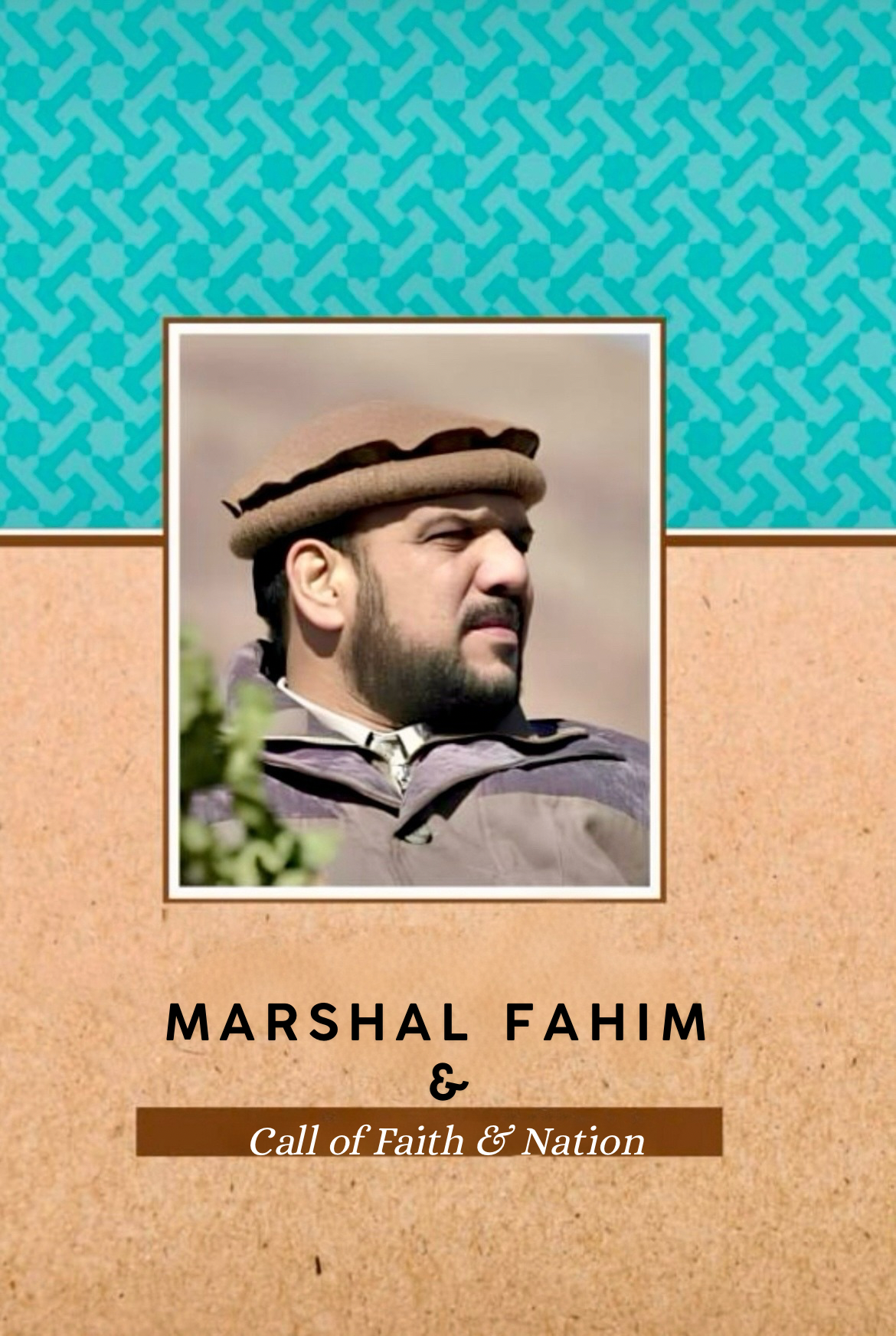
Name: Marshal Fahim: Call of Faith & NationPublished: Spring 2025Ava’ye Ra’na Publishing House |
| Download PDF |
Read Complete Text Here:
About The Book:
Marshal of Afghanistan: Call of Faith and Nation
مارشال افغانستان و داعیه ای دین و سرزمین
Selected Content from the Persian version published in
Spring of 2025
Paperback in 208 Pages
Avaye Ra’na Publishing House
Mashhad, Iran
Introduction
Marshal of Afghanistan: Call of Faith and Nation is a comprehensive tribute to Marshal Mohammad Qasim Fahim, one of Afghanistan’s most prominent military and political figures, whose life’s journey spanned jihad, resistance, and state-building. Published in spring 2025 by Avaye Ra’na Publishing House, this 208-page work serves as both a historical chronicle and a collection of reflections on the man who stood at the heart of Afghanistan’s tumultuous modern history.
The document opens with commemorative speeches by leading Afghan statesmen—including former President Hamid Karzai, Dr. Abdullah Abdullah, and Vice President Amrullah Saleh—delivered on the seventh anniversary of Marshal Fahim’s passing. These orations offer intimate glimpses into his character: a patriot of unshakable loyalty, a mediator in times of political discord, and a man whose personal integrity inspired trust across factions. His story is presented as a narrative of unity, resilience, and moral courage, reminding readers that his commitment was to the nation as a whole rather than to any single party or ethnic group.
Beyond remembrance, the work situates Fahim’s life within the broader sweep of Afghanistan’s modern struggles. The speeches and essays trace three distinct phases of his legacy: the ideological resistance to communism, the armed jihad against Soviet occupation, and the daunting challenge of post-2001 state-building. Contributors such as Mohammad Yunus Qanooni and Ahmad Wali Massoud stress his pivotal role after Ahmad Shah Massoud’s assassination, when he assumed command of the resistance and oversaw the transition from war to governance.
Interwoven with these reflections are eyewitness accounts of key battles, including the decisive defense of Andarab Valley, as well as testimonies to Fahim’s qualities as a spiritual and ethical leader—courageous, forgiving, and inclusive. His own voice is preserved in a full-length BBC Persian interview, where he discusses peace, reform, the role of the Mujahideen, and the future of Afghanistan, underscoring his insistence that peace must come through dialogue and national sovereignty, not imposition.
Together, these pages form a rich mosaic of memory, history, and vision. They invite the reader to engage with Fahim’s enduring message: that Afghanistan’s dignity lies in unity, democracy, and the right of its people to shape their destiny. This collection is thus not merely a retrospective homage but also a call to action—urging Afghans to continue the work of building a sovereign, peaceful, and inclusive state.
A Patriot Who Loved His Nation
Speech by Former President Hamid Karzai
9th March, 2021
Kabul, Afghanistan
In the name of God, the Most Merciful, the Most Compassionate.
All praise be to God, Lord of the worlds, and peace and blessings upon the noblest of messengers, the Seal of the Prophets, a mercy to all mankind, our master Muhammad, and upon his family and companions.
My most honorable and dear brother, the respected Chairman of the High Council for National Reconciliation, Dr. Abdullah Abdullah; our very esteemed deputies and friends:
Mr. Qanooni, former Vice President; Mr. Mohaqiq; our former Minister of Foreign Affairs, Salahuddin Rabbani; Ahmad Zia Massoud, former Vice President; the Speaker of the House of the People; and indeed, a man of letters, the son of our beloved Marshal, Adib Fahim, former Deputy of National Security.
To the honored elders of our nation, our dear sisters and brothers, our youth, our respected Senators and deputies of the Senate—welcome, all of you.
We have gathered here today to honor the memory of the late Marshal. Truly, it is a day of sadness for us, because the Marshal of Afghanistan is no longer with us. Yet whenever his name is mentioned, I feel happiness, for he was my close companion and friend—in my personal life, in our national struggles, and in politics. Together we worked in government, we debated, we argued, but always in the spirit of building this nation slowly, step by step. There were differences, yes, but always unity, always friendship, and always for the good of Afghanistan.
Let me share with you a story. Once, in a cabinet meeting, we disagreed on a certain matter. Marshal Fahim said one thing, I said another, and the ministers shared different opinions. The meeting ended. He went his way, I went mine, and the matter was done.
But the next morning, as I entered my office, I found Marshal Fahim already standing there. I asked, “Marshal, what are you doing here so early?” He replied, “I came to ask how you are.” I said, “Why? What’s the matter?” He said, “Yesterday, we had a fight.” I told him, “We didn’t fight—we only discussed.” He said, “So you are not upset?” I said, “Not at all.” He smiled, said, “That makes me very happy. Now I leave you in God’s care.” That was the kind of man he was—genuine, filled with heartfelt friendship and affection.
There are many such memories. Once, over a very important national issue, he, Khalili Sahib, and I met often in private. We debated it for nearly a year and a half, with different views, but not once did our discussions leak outside. It was a matter of state, a matter of trust. In the end, we reached agreement. One day, I will share with you what that issue was.
May God grant him paradise. He loved this country deeply—its dignity, its prosperity, its honor. I recall once, when a foreign guest was scheduled to meet me, I asked him to join. He refused. When I asked why, he reminded me of something that guest had done years earlier, against our counsel. That was his patriotism—his loyalty to Afghanistan was unwavering.
Later, when I asked him about party politics, he said, “I no longer involve myself in such things. I am the Marshal of Afghanistan. I belong to every corner of this land, to all of its soil.”
And yes, the story of the two stones that Vice President Saleh mentioned is true. It carries a lesson. In an international gathering, Marshal Fahim once said, “In Afghanistan, these gemstones are called by different names—here they are called ‘sang,’ (in Persian) in a different part of our country they are called ‘tigah (in Pashto).’ Both of them belong to me. Both are mine.”
My brothers and sisters, may God grant us peace soon—a peace with dignity, with honor. In an Afghanistan independent, free, and sovereign, at peace with the world. We may be poor, but we will not be less than anyone. An Afghanistan where our children can go to school without fear. Where we see the grandchildren of the Marshal walking happily to school in their own homeland, carrying the flag of their nation on their shoulders.
That was the dream of the Marshal of Afghanistan. May we one day achieve it.
May the memory of the Marshal be blessed.
We Must Speak to the Opposition
Speech by Director of Marshal Fahim Foundation
Adib Fahim
9th March, 2021
Kabul, Afghanistan
In the name of God, the Most Merciful, the Most Compassionate.
All praise is due to God, Lord of the worlds. May peace and blessings be upon the noblest of messengers, the Seal of the Prophets, the mercy of God to all mankind—our master Muhammad—and upon his family and his companions altogether.
Respected leadership of the Islamic Republic of Afghanistan, leadership of the High Council for Reconciliation, national leaders and elders, mujahideen, dear brothers and sisters—peace, mercy, and blessings of God be upon you.
I extend my gratitude to you all for your presence here today, at this memorial ceremony for Marshal Mohammad Qasim Fahim. I also send my prayers to the souls of our compatriots who, in recent days, have lost their lives in various tragic incidents—especially our noble scholars, a number of whom were martyred unjustly. May their souls rest in peace and their memory be honored.
I also wish to remember Gada Mohammad Khalid, a former jihadi commander and a close companion of our national hero, the martyred Ahmad Shah Massoud, who recently passed away.
Each year, in these memorial gatherings for the Marshal of Afghanistan, we strive to share aspects of his beliefs and convictions regarding peace, state-building, and support for our national security forces.
Marshal Mohammad Qasim Fahim, as both a military and political figure who spent more than two decades on the frontlines of war and in defense of our national values, always emphasized peace as a fundamental necessity for the people of Afghanistan. He would say: “Like other nations of the world, we too have the right to live.” He believed that the path to peace lay in mutual acceptance, understanding, and broad dialogue.
The late Marshal would often say: “We can only achieve peace if we also pay attention to the legitimate demands of our opposition.” He considered the responsibility for achieving peace to rest more heavily upon the statesmen and leaders of the country than upon the opposition. While he firmly emphasized peace, he also believed in the necessity of supporting the current government. He would say: “By learning from the past, we must build a strong and stable state. To create an inclusive and acceptable order, and to strengthen its foundations, we must rise above narrow ethnic, factional, or partisan interests.”
It is widely acknowledged that one of the distinctive qualities of the Marshal of Afghanistan was his consistent support for the Afghan state and government, in all circumstances. Even at times when he was not part of government, he stood firmly behind the major policies and national and international programs of the state, and strongly supported the then-President, HE Hamid Karzai.
We all share the hope that peace will come to Afghanistan—that the war will end, that the sacrifices of our people and our security forces will be honored, and that the achievements and values of the Islamic Republic will be preserved. This, too, was the aspiration of Marshal Fahim.
Thank you for your attention.
We Belong to The Land of The Sun
Speech by Vice President Amrullah Saleh
9th March, 2021
Kabul, Afghanistan
In the name of God, the Most Merciful, the Most Compassionate.
Honorable Dr. Abdullah Abdullah, esteemed head of the High Council for Reconciliation; the respected scholar Mr. Sarwar Danish, Vice President; and so many distinguished former vice presidents—Mr. Mohammad Younus Qanooni, Mr. Ahmad Zia Massoud—and the wise leader of Jamiat-e-Islami Afghanistan, our dear brother Salahuddin Rabbani. We warmly welcome the presence of the honorable former President Hamid Karzai; welcome indeed. We also greet our senior advisor on political and security affairs, a national leader, Ustad Haji Mohammad Mohaqiq; the respected ministers of the cabinet; Mr. Muslim Yar, chairman of the Senate; his deputy Mr. Izadyar; all the honorable members of Parliament; Senator Ms. Rahela Dostum, here on behalf of Marshal Abdul Rashid Dostum and the National Islamic Movement of Afghanistan; along with tribal elders, religious scholars, and youth. Peace, mercy, and blessings of God be upon you all.
First, I wish to thank Adib Fahim, the eldest son of the late Marshal, for organizing such a dignified, orderly, and national gathering—bringing together elders from all corners of Afghanistan to honor this day and to offer condolences. I also extend gratitude to the organizing commission, led by our dear friend General Abdul Saboor Qane. And let me thank the Chief of Army Staff, not only for supporting this ceremony but for wisely managing recent military operations.
We have often heard the late Marshal quoted—through the words of former President Karzai—saying: “If ever a day comes when I must prove my love and loyalty to this homeland, then the stone of Paktia and the lapis of Badakhshan will hold equal value to me.” By this he meant: I belong to every corner of this land, and every corner of this land belongs to me. I am in Afghanistan, and Afghanistan is within me.
And in the same spirit, how beautifully another has written:
“My father is the Pamir, my mother the green plains of the South.
My father is the pure spring water.
The young pine tree is my sibling, the old poplar too.
The tulips are my kin, my companions of faith;
All of us belong to the land of the sun.”
Today is a fitting occasion to remember the sacrifices of the Afghan nation, both military and civilian, and to extend condolences to their families. In recent months, what are called “targeted killings” have in reality been the most senseless, purposeless massacres. Our statistics show nearly sixty civil activists, tribal elders, religious scholars, journalists, and judges have been gunned down across Afghanistan. At first, attempts were made to deny responsibility, but such widespread crimes cannot be hidden. The evidence shows one group is behind these killings—the Taliban.
If you count the killings of the past twenty years, they far exceed those carried out during the regime of the Democratic Party or by the Soviets. These killings stretch from Kandahar to Herat. Recall: the first great commander they captured and executed in cold blood was Alauddin Khan of Herat. This has long been their pattern. Yet with every assassination, every beheading, the Afghan people have not bowed; their resolve has not broken. Instead, these crimes have deepened resentment, sharpened the sense of revenge, and distanced the people from accepting the Taliban, making the process of peace ever more complicated.
Our great leaders who are no longer with us—such as the wise elder and torchbearer of peace, Professor Burhanuddin Rabbani—are deeply missed. Their absence leaves a void, but their path is not empty. Their cause and their party still endure, their vision still has followers. Our message to the Taliban is this: By killing our leaders, our politicians, our scholars who differ from you, do not imagine that you can win a place in the hearts of the Afghan people. Do not imagine that by fire and destruction you can dry up the garden of Afghanistan. For as the poet said:
“From the heart of the soil the roots of the flowers have not perished.
Even when the garden burned in flames,
a young sapling sang bravely:
‘Our burning is but another stage of growth;
we shall rise again, we shall bloom anew.’”
No amount of fire can consume this garden at its roots. For every tree cut down, another sapling rises beside it—and we see this across Afghanistan.
Allow me now to turn to recent disclosures. Having served six years and eight months as Director General of National Security under President Karzai, I say with pride that I learned never to keep truths locked within. Do not leave your heart burdened with unsaid words—speak them. History’s judgment is one thing, but more important is today’s judgment, and the judgment of the new generation.
Through the media you have learned of a letter delivered to the President of Afghanistan, which later leaked. What did we discuss with the visiting U.S. delegation? Let me be clear: our relationship with the West and the United States is fundamental—based on shared interests and mutual respect. But whenever our core interests are trampled, we must inform our people. Though financially and militarily weak, Afghanistan has never traded its dignity. Poverty has never made us see ourselves as less than others.
In two days of talks, lasting over four hours, we told the Americans: the essence of Afghanistan’s struggle, the will of the people, and the foundation of our system is this—we cannot strip our people of the right to vote. Under no condition, by no pretext, by no conspiracy, can we take away this right. Our people elect their provincial councils, their parliament, their president every five years. If the issue lies with the leadership, let us solve it through elections. But we will never agree to a closed-room deal by twenty individuals that dissolves the constitution, erases our system, undermines our achievements, and robs our people of their vote. Never—never—never!
Some ask me, what if such a deal is imposed? I say: even if I stand alone, I will say no. In our faith, standing against injustice is a principle. If that day comes, then better to be pierced by a Pakistani or Taliban bullet than to betray my nation and deny its right to vote.
Yes, the Taliban are a reality—bitter or sweet. We are prepared for peace with them. But peace has three kinds: imposed peace, which I reject both domestically and internationally; stalemate peace, born of maturity, when both sides realize they cannot eliminate each other; and genuine reconciliation. Let us abandon the politics of elimination, come before the people, and compete with ideas instead of guns and bombs. Let us sow seeds of love in this soil, not seeds of death.
On the second day, we spoke of Pakistan. The Americans admitted: Pakistan has acted only as a courier between them and the Taliban, never applying real pressure for peace. Pakistan recognizes two states in Afghanistan—the Taliban emirate and the republic. And so, they said, as long as the problem with Pakistan remains unresolved, meaningful peace talks with the Taliban cannot begin. Therefore, peace must have two layers: resolving the historic conflict between Afghanistan and Pakistan, and integrating the Taliban into Afghan political life, so they may speak to the people through politics, not violence.
At the heart of it all lies one principle: the right of the ordinary Afghan to vote. The proposals placed before us were shaky bridges to the future—bridges that would collapse under the weight of thirty million lives. Leadership is tested by whether one trembles at letters, bombs, and plots, or stands firm on principle.
We are not frightened by this letter. Our stance has not changed, nor will it. Sacrifice for peace means this: let us sit tomorrow and talk about elections. Bring five hundred thousand observers if need be. But never take away the people’s right to choose.
Yes, we are poor, dependent on aid, but our pride and dignity have never been broken. I recall when the martyred Ahmad Shah Massoud first sent me to Washington, he told me: “You go not as a representative of our refugees or our poverty, and you must not ask them for money. You go to deliver the message of the authenticity of our resistance—and nothing else.”
And so, I end with this: Peace is a necessity. Only those who have held the trembling body of a grieving father, only those who have wiped the tears of widows and orphans, truly know what peace means. But let it be peace with dignity, peace that respects diversity, peace that does not undermine our unity.
And from God comes success.
We Must Seek Peace
Speech by Chairman of Peace Council Dr. Abdullah Abdullah
9th March, 2021
Kabul, Afghanistan
In the name of God, the Most Merciful, the Most Compassionate.
Honorable audience, my very dear brother, His Excellency Hamid Karzai, former President of Afghanistan; my dear brother, Mr. Amrullah Saleh, First Vice President; Second Vice President, Mr. Sarwar Danish; esteemed leaders of Afghan politics, jihadi and political leaders of our country, respected ministers of the cabinet, the Speaker of the Senate, dear brothers and sisters—peace, mercy, and blessings of God be upon you.
At the outset, I extend my condolences to the eldest son of the late Marshal, our dear brother Adib Fahim, to his family, to the respected elders gathered here, to the youth who have joined us, and to the mujahid people of Afghanistan.
Today marks the seventh anniversary of the passing of Marshal Mohammad Qasim Fahim. As President Karzai mentioned earlier, on the one hand we feel the absence of great men—especially in the difficult days of our nation—an absence that cannot be replaced. On the other hand, their remembrance allows us to recall their achievements, their history, and the spiritual legacy they left behind.
Marshal Sahib was one of the great leaders of jihad and resistance, who played a decisive and pivotal role in opening a new chapter in Afghanistan’s history. May God bless his soul and grant him the highest paradise.
At the same time, our nation has endured many sacrifices over the years. We pray for the souls of all Afghanistan’s martyrs. As you can see from the portraits displayed in this hall during Martyrs’ Week, the images of our martyrs fill the space. The martyred Ustad, leader of Jamiat-e-Islami and President of the Islamic State of Afghanistan, the Martyr of Peace who gave his life for the cause of peace—a cause which today, on the seventh anniversary of Marshal’s passing, is the very theme chosen for our discussion and for the aspirations of our entire people.
We remember too Ustad Abdul Ali Mazari, Martyr of National Unity; Martyr Haji Abdul Qadir; Martyr Commander Abdul Mutalib Beg; and hundreds of other martyrs, both renowned and unknown, who sacrificed their lives not for personal interests, but for a higher cause: in the way of God, in defense of faith and freedom. May God grant them eternal peace.
We must also acknowledge and appreciate the sacrifices of our defense and security forces, who even today stand at the frontlines to defend the values for which our people have made such sacrifices—in truth, to defend peace itself. I thank the commission responsible for organizing this seventh anniversary of the Marshal’s passing, and I pay respect to all our security and defense forces and their families, who have worked tirelessly to ensure security for this gathering.
Much of what the late Marshal said—whether in his speeches, in clips we have seen, or in books written—reflects his vision of peace for this country. His first words summed it all: we must seek peace, we must be ready for sacrifice in its cause, we must be ready to accept one another, and we must listen to each other. All of his thoughts could be summarized in these principles.
I do not wish today to speak at length about current affairs, but it is also unavoidable, for our people expect some words. Afghanistan throughout history has faced great tests. I believe today we are once again at such a turning point, a great test before the Afghan people. On one side, our entire people demand peace—a peace with dignity, a peace that guarantees the rights of all. On the other, there are urgencies and pressures beyond our control.
But I am certain: the Afghan people, who have lived with honor, who have sacrificed for their dignity and pride, have rightful demands—and they seek the fulfillment of these demands. War has taken countless sacrifices from Afghanistan, and we have lost many great figures—hundreds, perhaps thousands of leaders—yet the suffering continues daily.
For this reason, I thank all those who work for the security of our people—people who have endured forty-two years of hardship and calamity. Each day in Kabul, when mothers bid farewell to their children going to school or to work, it is with heavy hearts. This is the daily story of millions in this city alone. Afghanistan today faces the most complex of circumstances—security and military challenges, political crisis, international pressures.
In these past thirty to forty years, history has placed Afghanistan in crisis time and again. Throughout, Marshal Mohammad Qasim Fahim was a central figure—present at historic moments. He was there during the peaceful transfer of power from the Islamic State of Afghanistan under Martyr Professor Burhanuddin Rabbani to the Transitional Government led by President Karzai. We were all part of these processes, and we must acknowledge: mistakes were made, which no one can deny.
In recent days, the issue of a letter has been raised. Two days before the visit of the U.S. delegation led by Zalmay Khalilzad, the American embassy delivered a letter to the President, and another to us. Both were later shared with the media, and much commentary followed. The letter, coming from a partner country, acknowledged Afghanistan’s independence must be respected and strengthened, and that our sacrifices in the cause of humanity should not be forgotten. The letter reflected urgency from the international community.
I am not here to defend or justify it. But I ask: for the people of Afghanistan, who give daily sacrifices, is peace not urgent? Is peace not necessary? Yes, it must be peace with dignity, lasting peace, peace that guarantees rights for all.
I recall when President Karzai, along with a delegation, returned from Rome and visited Martyr Ustad in Badakhshan. There the question was asked: what is the way forward? He replied: strengthening resistance inside, reinforcing national unity, building broader coordination, exerting pressure on the country supporting the Taliban, and mobilizing international cooperation. He stressed that in a Loya Jirga, we must be participants, not guests. If our identity as Afghans is recognized, we will be there. And the ultimate principle: one person, one vote.
This is the foundation of democracy. And this is our guide even today.
When we remember Marshal Sahib, as President Karzai rightly said, he was a sincere man, a friend, a companion. We would visit him often, with no formalities—just a phone call, and we would meet. One of his qualities was that he always kept his phone by himself. Even a farmer from the farthest village who knew him could call, and he would answer personally. Sadly, none of us have carried this forward.
And in his hardest moments—even when upset—Marshal of Afghanistan never plotted against anyone. No one can claim that he conspired against others. He had a big heart. In one of his speeches, when he spoke of peace, you can see his tears nearly fall. He said: we need peace. And he meant it from the depth of his heart and soul.
No one in this country is against peace. But we must accept: because of internal conditions and external pressures, Afghanistan today stands at a historic crossroads. Nothing can be imposed on the Afghan people by force. Division, discrimination, discord—these may impose hardships, but true peace and dignity cannot be forced.
We must therefore demonstrate our capacity to unite the Afghan people. If we do, the people will stand with us and sacrifice tenfold. If we fail to show it, then blaming foreigners will not help.
So, when we honor Marshal Sahib today, we honor a man who was sincere, a true friend, a believer in national unity and justice. And in honoring him, we honor our shared values and aspirations as a people.
Thank you all for your presence. May peace, mercy, and blessings of God be upon you.
A Man of Integrity
Speech by Mohammad Mohaqiq Leader of the People’s Islamic Unity Party of Afghanistan
9th March, 2021
Kabul, Afghanistan
In the name of God, the Most Merciful, the Most Compassionate.
Honored guests, respected elders, and dear youth present in this gathering—His Excellency Hamid Karzai, former President of Afghanistan; the esteemed Dr. Abdullah Abdullah, Chairman of the High Council for National Reconciliation; the honorable Vice Presidents; our resilient brother Mr. Amrullah Saleh; the learned scholar Mr. Sarwar Danish; former Vice Presidents; the heir of the leader of jihad and resistance, Mr. Salahuddin Rabbani, former Foreign Minister; the Speaker of the Senate; the Speaker of the House of Representatives; our respected jihadi and political leaders gathered here; and the son of Marshal of Afghanistan, Mr. Adib Fahim—peace, mercy, and blessings of God be upon you all.
It is both a pleasure and an honor for me to be present in this important gathering. We cherish the memory of Afghanistan’s great martyrs and we honor the legacy of Marshal Mohammad Qasim Fahim. May God have mercy on them all and grant them peace in the hereafter.
I wish to share just a few words about the late Marshal of Afghanistan, and also touch briefly on the current state of peace and the pressing issues that our people are discussing today.
I became closely acquainted with Marshal Sahib during the time of resistance—when nearly the entire country had fallen into the hands of the Taliban and international terrorism. Fighters from all over the world had gathered in Afghanistan. Only a few provinces in the northeast remained free, while we ourselves were besieged for three years in the northern mountains and central regions. It was in Takhar that I came to know him more deeply. Though I had spoken with him before during the resistance, it was through these encounters that I truly felt his honesty, steadfastness, and faith in Afghanistan and its people.
He was the one upon whom the National Hero of Afghanistan, Commander Ahmad Shah Massoud, placed the greatest trust. Whenever problems arose, Marshal Mohammad Qasim Fahim was the one to resolve them. May God bless his soul and grant us all the ability to continue along his path.
Even after the victory of the mujahideen, throughout the transitional period and later phases of government, my acquaintance with him continued—sometimes while he was in government, sometimes when he stood in opposition. In all circumstances, we held many discussions on the destiny of our people, our jihad, and our homeland. Today, his absence is deeply felt among the Afghan people.
Because time is short, let me turn to the current conditions in our country. Although Afghanistan has always been in a sensitive state, today the situation is extremely delicate. Some even say that if we were to change the name of Afghanistan, it should be called “The Land of Sensitivities.” I too repeat that we are at a very sensitive moment: our people have nearly lost their ability to make decisions, while the world rushes to impose its own urgency on Afghanistan.
Let there be no misunderstanding—we are supporters of peace and brotherhood. We do not desire war. But everything must follow a natural course. Afghanistan has known both war and peace. Our people are tired of long wars; yes, the conditions demand peace. But what kind of peace? Some argue that because the people of Afghanistan and the world are weary of war, peace must come by any means—even if it means surrender to the Taliban. But we cannot accept such a peace or such conditions.
We fought for Islam, freedom, and independence. In the last twenty years, we struggled for democracy, freedom of speech, justice, and the great values our country has achieved. We cannot now abandon all these accomplishments.
Some design formulas saying the Taliban and the Afghan government must simply join together. But is this a real solution? What becomes of our constitutional system, our army, our police, our laws? Are we to leave all structures behind and retreat to the mountains? To what end—violence, killing? We have yet to hear from the Taliban any concrete vision of governance or law. Destroying Afghanistan’s foundations and trampling on rights is no solution. A true solution must come from consultation with the people of Afghanistan, with wisdom, prudence, and time—not through coercion or imposed deadlines.
We are told that the Taliban are ready for peace talks. Both internal and external voices say this. Yet what we have witnessed is different: violence has multiplied, assassinations of soldiers, police, judges, journalists, and civilians continue daily. Where is the reduction in violence? They said al-Qaeda and international terrorists would leave, but in many provinces they still operate together.
Meanwhile, there are those who attempt to paint the Taliban in bright colors, to portray them as “very good people.” But let us remember: it was the Taliban who massacred ten thousand people in Mazar-e-Sharif, who unleashed destruction from Faryab to Badakhshan, from the south to Shomali. They showed no mercy to people, to trees, or to our land. They executed seven innocent men in Jalalabad with their hands bound. What religion justifies this? Their methods have not changed. The Taliban are our brothers, yes—but brothers unfaithful to us.
I have also studied the recent message from the U.S. State Department. It contains positive points which we respect, and we acknowledge the sacrifices of international partners in rebuilding Afghanistan. But I see serious weaknesses as well. First, the tone shows either a lack of understanding of Afghanistan’s national composition or an unwillingness to recognize it—this is the root of future crises. Second, the message is commanding, as though peace could be ordered. But peace cannot come by decree. Peace must be a national and enduring process, built upon consensus. Third, I sense haste in the message. The Americans are packing to leave. But let me say this: we did not ask you to come, and we do not ask you to go. The Afghan people themselves will decide on peace. We are not so weak that we will collapse when the United States departs.
My own memories from the days of resistance remind me of this: when the Taliban declared they had taken 95% of Afghanistan, Marshal Dostum called me to Mashhad for consultation. From there, I traveled to Tajikistan, and on to Commander Ahmad Shah Massoud in Khwaja Bahauddin. He asked me: where have you come from, and where are you going? I told him: I have come to share the burden of war with you. He asked how. I replied: give me a plane to the northern mountains, where thousands of my comrades are waiting. He agreed. I went to Balkhab with almost no resources—only a few thousand dollars, not enough even for my guards. For three years we resisted with hunger and displacement, fighting battle after battle. By God’s will, we survived and continued the resistance.
Now that we speak of peace, yes, we are ready. But we will never accept the Taliban’s dark domination. Those who send us letters must understand the real conditions of Afghanistan, and must not order us down paths that lead to dead ends.
I will not take more of your time.
Peace, mercy, and blessings of God be upon you.
State Building in Afghanistan
Remarks by Mohammad Yunus Qanooni Former Vice President
9th March, 2024
X Spaces (Formerly Twitter)
In the name of God, the Most Merciful, the Most Compassionate.
Greetings to all dear brothers and sisters who have gathered in this space on the anniversary of the passing of our late Marshal. I thank the organizers of this program. Such gatherings, on the one hand, commemorate the great figures who became part of Afghanistan’s history and left behind lasting achievements. On the other hand, they provide lessons and guidance for our younger generation and for the future of our country.
Dear friends,
As one of the speakers in this gathering, allow me to begin my remarks by offering prayers for the pure souls of the leaders of jihad and resistance: the martyred Professor Burhanuddin Rabbani, martyr of peace in Afghanistan; the National Hero of the country, the martyred Ahmad Shah Massoud; and especially for the soul of our late Marshal.
The theme chosen for today’s program—“Marshal of Afghanistan: From Resistance to State-Building”—is both timely and meaningful. I will keep my remarks focused within this frame.
Three Phases of Struggle
My acquaintance with the late Marshal Fahim goes back to my school days. Speaking of him reminds us of three great chapters in Afghanistan’s struggle.
The first chapter was the intellectual and ideological struggle, which emerged in response to the wave of communist ideology that swept Afghanistan. At that time, great personalities such as the martyred Rabbani, Ustad Niazi, and Engineer Habib ur-Rahman founded the Islamic Movement of Afghanistan to counter communism. It was in his youth that Mohammad Qasim Fahim joined this movement, becoming part of that early intellectual and political resistance.
The second chapter was the era of armed struggle, or jihad, which began with the Soviet invasion. For that young generation, jihad was not only a religious duty but a historic responsibility. They moved from intellectual resistance to armed resistance, and for fourteen long years fought the Soviet occupation. Among them was Marshal Fahim, who, alongside the National Hero Ahmad Shah Massoud, took up arms from the earliest days of jihad. Though Massoud’s leadership was singular, Marshal Fahim’s role within the military, political, and cultural teams of the resistance was vital. He was often sent by Massoud beyond Panjshir—to Kunduz, Kohdaman, and the northern provinces—to unify mujahideen ranks, resolve disputes, and bring order to the struggle.
The third chapter began after the withdrawal of Soviet forces and the establishment of the mujahideen state under President Rabbani. This phase tested the fighters in governance. Instead of peace, imposed wars erupted—first instigated by Gulbuddin Hekmatyar, and later by the Taliban, created by Pakistan’s ISI to prevent the consolidation of the new Islamic State. Thus began the struggle against terrorism.
The Role of Marshal Fahim
When Kabul fell and the government retreated to Panjshir and later to the north, Marshal Fahim was again a key figure. His military leadership in the north and northeast, under the command of Massoud, was irreplaceable. After the assassination of Ahmad Shah Massoud—planned in coordination with the 9/11 attacks—Afghanistan’s resistance was struck by a thunderbolt. In that moment of despair, it was Marshal Fahim who accepted the immense responsibility of filling the void, ensuring the continuity of the resistance until the fall of the Taliban. This was not privilege—it was duty, carried out with courage and sacrifice.
With the fall of the Taliban, Afghanistan entered the era of state-building. This transition—from armed resistance to political competition—was, in fact, harder than military struggle. Fighting with weapons was straightforward compared to the complexities of building consensus in an open political environment. Yet Marshal Fahim played a central role in this new chapter as well—sometimes as Vice President, sometimes outside government, but always as a key pillar in political and national processes.
State-Building and Its Challenges
After the Bonn Conference, Afghanistan attempted to build a national state. But from the beginning, internal divisions emerged. The United Front, which had filled the state institutions after 2001, now needed to share power with other ethnic and political groups. Marshal Fahim insisted that state-building required compromise and inclusion. Yet, resistance from within and manipulation from outside hampered this process, and a domestic opposition even arose within our own camp.
Still, two historic opportunities emerged in which Marshal Fahim played a decisive role:
- The drafting of the new Constitution. Had the delegates succeeded in transforming the centralized presidential system into a decentralized one, our history might have been spared later crises. Unfortunately, this opportunity was lost.
- Elections. For the first time in Afghan history, people’s votes became the basis of legitimacy. In several elections, we had the opportunity to bring change through democracy—something Massoud himself had always emphasized. Yet once again, these chances were squandered, paving the way for Ghani’s disastrous rule.
Closing Reflections
Dear youth,
The transformation of military confrontation into political competition was an achievement, but hostility and rivalries persisted beneath the surface. External actors, particularly the United States, imposed ready-made packages of regime change, post-conflict arrangements, and state-building models—often sowing division instead of unity.
Through all this, Marshal Mohammad Qasim Fahim remained a steadfast and central figure, whether in power or out of it. His life and legacy are woven into every chapter of our recent history: the intellectual struggle, the jihad against Soviet occupation, the resistance to terrorism, and the challenges of state-building.
Once again, I send prayers to the soul of our late Marshal, and I thank each of you for your patience and attention.
May God protect you all.
We Must Be Inclusive
Remarks by Lieutenant General Nasir Ziyayee
Former Kabul Army Garrison Commander
9th March, 2024
X Spaces (Formerly Twitter)
In the name of God, the Most Compassionate, the Most Merciful.
Greetings to you and all the guests of this program; I send blessings to the souls of all the martyrs of Afghanistan in the era of Jihad, Resistance, and in the ranks of the country’s defense and security forces. I thank those who organized such a program on the occasion of the heavenly passing of the Marshal of Afghanistan.
Dear brothers and sisters!
There is no doubt that Afghanistan has been struck by events at various points in its history. These events were imposed upon the Afghan people. Here we do not intend to review these events throughout history, but will only discuss the era of Jihad, the Resistance, and the Reconstruction of Afghanistan — and how the Marshal acted during these periods.
We knew Marshal Mohammad Qasim Fahim before the Jihad and the communist coup as a student at the Abu Hanifa School, where he was a young man studying. When the Jihad began and the people of Afghanistan, with empty hands, rose up against the communist coup and the invasion of the Soviet Union, Marshal Fahim joined the ranks of Jihad.
His Jihad began in the southern regions, especially in Kunar. If you ask the noble people of Kunar, they all speak well of Marshal Fahim. He also had many memories from the time of Jihad and would always speak about those memories related to Kunar and Nuristan. When he returned to Panjshir, he continued the struggle under the command of Martyr Ahmad Shah Massoud, the National Hero of Afghanistan. At that time, the Panjshir front was one of the well-known and important bastions of the people’s Jihad.
One of the periods when the people came together with complete unity and fought side by side was the Jihad. Marshal Fahim, alongside Ahmad Shah Massoud, mobilized the people, especially the youth, until the areas of presence and influence of the fronts expanded day by day. Marshal Fahim worked in the Parwan–Kapisa front under Jamiat-e Islami of Afghanistan, which was led by the National Hero, and made many efforts to organize the people and expand the struggle until the Supervisory Council (Shura-ye Nazar) of Jamiat-e Islami was formed.
He was one of the important and prominent figures active in the political committee of this council and continued his efforts and struggles there. Marshal Fahim sought to create unity within the framework of Jihad — regardless of which language someone spoke or to which party or faction they belonged. He built very close relations with different parties and tribes in different zones.
Because Jihad was also a value-based and faith-based process — nationally connected with the tribes, politically with the parties, and spiritually with all the Mujahideen — he worked based on the strategy set within the Supervisory Council. Let us not forget that the Supervisory Council was composed of commanders of various Jihadi parties and played a very significant and vital role in achieving the goals of the people’s Jihad and became a principal force.
Within the framework of the council’s objectives and plans, the Marshal made many efforts until the Mujahideen achieved victory and entered Kabul. Marshal Fahim, as Minister of National Security, was responsible for the defense of Kabul, and with courage and composure he was able to successfully fulfill his duties. He played a very crucial role in mobilizing the people to support the state, mediating between parties in support of the state, and coordinating among commanders for the defense of the state.
Marshal Fahim, during the retreat from Kabul and the creation of the United Front within the framework of the Islamic State of Afghanistan and in the territory of the Resistance Front, was one of the prominent and leading figures. When Ahmad Shah Massoud was alive, Marshal Fahim had his own place. Wherever Massoud was absent, Fahim was present; and whenever Massoud was occupied with something, everyone said, “It is good that Fahim Sahib is here.” Everyone considered his role valuable.
After the martyrdom of the National Hero of Afghanistan, it was clear that he had no successor, but the most creative personality, the one most prominent in public opinion, was Marshal Fahim. Across the North and South of the Hindu Kush — from Dr. Ibrahim Malikzada in Ghor to Haji Hazrat Ali in the East — when they could not find Ahmad Shah Massoud, they contacted Marshal Fahim for guidance.
Although during Massoud’s life he would do nothing without his approval, Marshal Fahim had so much confidence and assurance that he knew Massoud would support the orders he gave. As we saw, in every case where Marshal Fahim took action, it was supported and endorsed by Ahmad Shah Massoud.
When Ahmad Shah Massoud was martyred, the only person that the President of the Islamic State of Afghanistan, Martyr Professor Burhanuddin Rabbani, recognized as able to organize the chaos of war and restore trust for continuing the Resistance was Fahim Khan. With this understanding, and after consultations and consensus among commanders and political and military figures across Afghanistan, the leadership of the state officially entrusted him with the succession of Ahmad Shah Massoud.
Because of the legal and moral standing he held among the people — and the broad-minded way he dealt with everyone — he reached this position.
With the opening of a new chapter in Afghanistan, despite the opposition of the international community and regional powers, Marshal Fahim considered himself duty-bound and ordered that all forces and military units enter Kabul so that the capital would remain safe from theft, looting, and revenge-taking.
As a responsible statesman, he issued this order and re-entered Kabul, creating the grounds for political dialogue.
Thus began the reconstruction period.
Here we briefly review the personality traits of Marshal Fahim in four dimensions:
- A Great Spiritual Personality:
He was a believer, relied upon God, prayed, and worshipped. He was highly conscientious and very ethical. No one witnessed any moral corruption on his side, whether in his youth or later years. - A Noble and Forgiving Man:
Politically, Marshal Fahim bore no personal enmity toward anyone. He did not seek revenge, was always forgiving, welcomed others with a smile, and would say that a mistake had surely been made or there had been incitement, and we must move past it. He was always generous with the people in both good and bad times. - Courageous:
During the Jihad he was very brave, took initiative, and showed no hesitation in his will. Whatever he determined to be right, after consulting a few people, he acted upon.
During the coup against the Mujahideen government in Kabul, as Minister of Security and Commander of Kabul’s Defense, he calmly and with manliness, politically and militarily, was able to foil that coup.
After the martyrdom of Ahmad Shah Massoud, his heart did not tremble, he did not fear, and he fully accepted the responsibility that was entrusted to him. - An Ethical Politician:
Marshal Fahim was an ethical statesman who acted based on affection, ethics, and friendship — not personal gain. He was never discriminatory in politics and always interacted with the people sincerely.
I have many memories with Marshal Fahim, and here I will share one as an example.
After the Mujahideen’s return to victory, when we were in the Ministry of Defense and Marshal Fahim, as Vice President, was responsible for the Ministry of Defense, he always emphasized that we must be inclusive.
He used to say: “Afghanistan is our country. In the past, it has gone through very difficult times, and big games are yet to be imposed upon it. We cannot face these challenges alone. We must prepare the new generation according to their own time and ensure that our people have a role — politically, militarily, culturally, and economically — in every field.”
Another memory is from the time of the Resistance. In 1997, while we were talking with some commanders — including the late Gada Mohammad Khalid, the late Abdul Momen Shaba, the martyred Bahlol Baheej, Commander Mirza Rahim, and Engineer Wasil — Marshal Fahim came and said we must propose to Ahmad Shah Massoud that we provide technical educational opportunities for some of our cadres and youth in one of the countries that has relations with us.
He said our generation is slowly growing old and that after victory we must have administrative cadres so that our forces are not only engaged in military affairs, as happened after the fall of Najibullah’s regime.
When Ahmad Shah Massoud arrived, Marshal Fahim frankly raised this point and said that we must address this shortcoming. Ahmad Shah Massoud agreed, and a few years later, based on this plan, an understanding was reached with one of the countries.
Here I end my remarks and thank all the brothers and sisters who are present and who organized this program.
Defeating the Taliban in the Andarab Valley
Remarks by Lieutenant General Mustafa Andarabi
Former Police Chief of Ghor
9th March, 2024
X Spaces (Formerly Twitter)
I would like to briefly share some of the qualities and memories of Marshal Mohammad Qasim Fahim, based on our shared years of cooperation and joint struggle.
During the First Resistance in late 1990s, Marshal Fahim was assigned by Ahmad Shah Massoud to Baghlan Province, and specifically to Andarab. At that time, the Taliban launched an assault on Andarab and wanted to reach Panjshir through the Khawak Pass. They captured those areas, forcing us to withdraw and retreat to the foothills of the Hindu Kush — the same areas where today’s Resistance Front forces are based.
After a few days, the Marshal of Afghanistan came to Khwost. We sent him a message, and he came to the mountain foothills where we were based. Eventually, we devised a plan. The eight-thousand-strong Taliban force that had entered Andarab was targeted through coordinated planning and the cooperation of all the commanders and fighters of Andarab.
Marshal Fahim was positioned in a small shepherd’s hut high in the mountains, at an altitude of nearly four thousand meters. We descended toward the Qasan Valley to launch our operation. At night, we expelled the enemy from Qasan and moved toward the district center. Commander Khalil Khan launched pressure from the Pul-e-Hesar district side, while another force attacked from the Khawak Pass side, and this eight-thousand-strong force was completely scattered and defeated.
You should know that Marshal Fahim, even at that high altitude and in freezing weather, maintained communications with all commanders and Mujahideen. These coordinated efforts led to success, and we were able to completely drive the Taliban out of all three districts of Andarab.
At that time, everyone feared that the First Resistance was over and that the Taliban would enter the Panjshir Valley. The courage and bravery of the youth of Andarab — and especially the leadership of Marshal Mohammad Qasim Fahim — led to this great victory.
Afterward, Marshal Fahim walked four hours down from those high mountains to reach our village. There, he helped organize and coordinate the operation, and gave orders on dealing with the Taliban prisoners. Marshal Fahim received instructions from Ahmad Shah Massoud: all of the Taliban’s captured weapons and equipment were to distributed to the local forces in the area. Among those nearly captured was Mullah Baradar, who narrowly escaped.
Thanks to that operation, Andarab remained safe from Taliban attacks for another three years.
I personally knew Marshal Fahim closely, I can say he had very admirable qualities. He was a highly social person, living and engaging with the people and respecting their customs. He had vast experience and ultimately was able to lead the Resistance Front effectively after the martyrdom of Ahmad Shah Massoud. Despite the difficulties and gaps that existed, Marshal Fahim fulfilled his duty.
A Man of Faith & Piety
Remarks by Ahmad Wali Massoud
Director of Massoud Foundation
9th March, 2024
X Spaces (Formerly Twitter)
In the name of God, the Most Compassionate, the Most Merciful.
First, I would like to thank all the respected participants of this program and those who organized this space and made it possible. At the same time, we mark the tenth anniversary of the passing of the late Marshal Mohammad Qasim Fahim together with the martyrs of the month of March — as friends mentioned, Martyr Ustad Abdul Ali Mazari, Martyr Mohammad Panah, Martyr Abdul Rahman Sayedkhili, and the martyrs in Herat — and we send blessings to their souls.
We also send blessings to the souls of all the martyrs of the First Resistance and the Second Resistance — without whom today we would have neither the story of Resistance nor an open window toward the freedom of our country. Honoring the shining figures of our nation, as we are doing today in commemorating Marshal Fahim, is a very noble and praiseworthy tradition so that we may benefit from the lessons of these great men for our present-day struggles.
These were men who, in the most difficult battles and days, brought victory to Jihad and Resistance and earned countless honors. Today we remember them, salute their souls, and honor their legacy.
Holding such programs is very useful so that the young generation may know how the past unfolded and understand that we must organize and continue our own struggle according to those same guidelines, so that we may move toward progress and improvement.
When we speak of resistance and struggle today, it is because we see that our country is still very far from peace, stability, and other necessities of a normal life. God forbid that we become engaged in activities that divert us from the real path — the path that our great leaders walked, the path that led to victory.
The more we can strengthen and broaden this narrative, the better. We must speak about it, refine it, and improve it, rather than becoming discouraged or hopeless and saying: “It cannot be done anymore — maybe in the past it was possible, but now things have become too complicated; let us look for easier ways and say that if the world decides, that is how it will be.”
In my view, the world has already decided — but we saw that the result of that decision was a dark day for us. It is better that we not wait too long for the world’s decision. Our country is ours, our dignity and our home are ours — we must take action ourselves.
In these past three years we have been watching as the world handed over Afghanistan to the most ruthless group known as the Taliban. They have scattered our people and placed us in a very bad situation. If we keep waiting, our condition may become even worse.
It is better that we achieve awareness and learn to recognize the enemy, to see where we stand, where we are going, how we can decide, and how we can organize our forces. This is of the utmost importance.
I would like to point out a few things about the record of Marshal Fahim:
Marshal Fahim was one of the closest companions of the National Hero of Afghanistan and among the first figures of the Islamic Movement of Afghanistan. He had a brilliant record, and the multidimensional nature of his personality made him one of the great historical figures.
I wish to recall a few things I personally witnessed:
Marshal Fahim was a believer and a Muslim, and he acted on what he believed. Over the years I sat with him many times and became convinced that he never turned away from the path he had chosen — especially in matters of personal faith, piety, and religious devotion. He never abandoned what he believed to be right.
He also remained committed to the Jihad and Resistance of the Afghan people until the end of his life. Although during the past twenty years many political ups and downs occurred, and tastes and approaches changed, Marshal Fahim never turned away from his original and grand path. He stayed true to his commitment to Jihad, to the Resistance, and to the Mujahideen and resistance fighters — for him, this was a principle.
Another aspect I personally witnessed was his social nature. He interacted with a wide range of people — intellectuals, Mujahideen, scholars, commanders — and maintained an honorable relationship with all, treating each according to their way. He had a subtle charm that could attract people to him.
Many might have assumed that because Marshal Fahim was a military man, a Mujahid, and a resistance fighter who had spent years on the battlefield, he might be harsh. But when you sat with him, you realized how much gentleness and refinement he had within him, how he could attract people and open the door to dialogue. This was another important dimension of his character.
Marshal Fahim was free of grudges, patient, and tolerant. During the state-building period, there were many disagreements, conflicts, and comings and goings — yet every time we went to meet him, it was as if nothing had happened.
Among the major things that Marshal Fahim accomplished — as Mr. Qanuni has mentioned — was taking responsibility after the martyrdom of the National Hero of Afghanistan, in extremely difficult circumstances, when no one was ready to fill that void and everyone was in tears. In that sensitive moment, he risked his life and accepted this historic responsibility, which history will forever record.
As Mr. Izadyar also mentioned about the the decision of Marshal Fahim to march forces into Kabul, despite foreign advice not to enter the city, I remember well that when I was in England, the British Foreign Ministry, through Dr. Abdullah, had said not to enter Kabul yet because they had certain matters to arrange in Bagram and elsewhere. I remember clearly that Marshal Fahim, after consultation, said: “No — we will enter Kabul, and we will not allow anyone else to enter Bagram without permission.”
These are examples that I personally witnessed.
No matter how much we speak about the character and achievements of Marshal Fahim, it will not be enough. He is one of the enduring figures of Afghanistan’s history, especially in the era of Jihad and the people’s Resistance. It is best that we draw lessons from his record.
I will not speak more and pray that God be pleased with the soul of Marshal Fahim and all the martyrs of Afghanistan’s Jihad and Resistance.
We Must Make Peace
Text of Marshal Fahim’s Interview With BBC Persian’s Daud Qarizadah
11th, June, 2011
BBC Persian: In Other Words
Daud Qarizadah: Marshal Mohammad Qasim Fahim, welcome to the program “In Other Words.”
Marshal Fahim: Thank you. Bless you.
Daud Qarizadah: What made you concerned about Afghanistan’s situation—to the point that you even spoke about the possibility of the country returning to the Taliban era?
Marshal Fahim: In the name of God, the Most Compassionate, the Most Merciful. You know that over the past three decades Afghanistan has passed through difficult and harsh phases, and day by day the situation had become more crisis-ridden. However, after the establishment of the Interim Government, political stability emerged in this country, national unity was secured, and government administrations and institutions were revived. A new life began to take shape here.
Daud Qarizadah: Setting aside what has happened over these ten years, tell us specifically about your concerns—what, exactly, is causing your worry?
Marshal Fahim: On this point I would say: the efforts underway in Afghanistan today—the ongoing political struggles—on one side, there is war in Afghanistan; you know the causes of the war, the areas where it is being fought, and the daily terror, murder, and killings in this country. On the other side, a majority of people are, very short-sightedly, trying to bring down the system in Afghanistan.
Daud Qarizadah: Whom do you mean by “some people”?
Marshal Fahim: Mostly political currents, political figures, and young people are thinking this way. Young people, by nature, want everything quickly. That is why my concern is this: when the communist regime fell in Afghanistan, the Mujahideen were a strong alternative that filled the vacuum. When the Taliban fell, the Government of Afghanistan—though it had been pushed out by the Taliban—returned and filled the void. God forbid, if today the system and the state were to fall in this country, I can say with certainty that there is no organized, reliable, credible group for the people of Afghanistan to come and fill the place of the state.
Daud Qarizadah: If by that you mean the political opposition led by Dr. Abdullah—who, along with others who were once your comrades, are calling for reforms in government, not the government’s collapse?
Marshal Fahim: Reform is one matter; working for collapse is another. We also support the introduction of reforms; our brothers likewise support reforms in Afghanistan. We are striving to bring about reforms.
Daud Qarizadah: So you are saying there are those who intend to bring down the state?
Marshal Fahim: Dr. Abdullah has ample political understanding. I mean the political opposition in general.
Marshal Fahim: If Dr. Abdullah is at the head of the political group “Change and Hope,” then—thanks be to God—he has that political understanding. He has served as Foreign Minister of Afghanistan; he knows what the challenges of state-building in Afghanistan are. He knows exactly the problems faced by the Afghan government and by political figures more broadly. But there are individuals who are trying to shake the foundations of the state.
Daud Qarizadah: What is your relationship with Afghanistan’s political opposition at present?
Marshal Fahim: Very brotherly, close, and friendly. There is no problem between us and them; indeed, we meet, talk, and sit together with those same brothers with whom we shared a lifetime.
Daud Qarizadah: Meaning you regularly take part in their meetings?
Marshal Fahim: We sit together in meetings; they come to our home and we go to theirs. We share views by phone as well. We have no problem.
Daud Qarizadah: So you are both First Vice President of Afghanistan—and, at the same time, in contact with the opposition?
Marshal Fahim: I am the First Vice President of Afghanistan. Being in government and being the First Vice President means not only that I support the government’s programs as I wish, but that I also want my friends to be part of this collective. Because I have lived closely with them, we have an understanding and are close to each other. We are not, in essence, adversaries.
Daud Qarizadah: Ten years ago, after Ahmad Shah Massoud was killed, you took charge of operations against the Taliban and pledged to continue Massoud’s path with his companions. But today, a criticism of you is that you have your own path and his companions have theirs.
Marshal Fahim: That is not the case [smiles]. From the very first day that Jihad began in Afghanistan—in 1358 (1979), when the armed struggle started in the Panjshir Front—I was with Ahmad Shah Massoud until the day he was martyred. On every path he mapped out, I was his partner. After the Martyr Ameer (Massoud) was killed and Afghanistan became free, step by step I implemented this political path: the Interim Government was formed, the Transitional period came, the Constitution was established, and we took all necessary measures; eventually the ground was prepared for elections. All the weapons and equipment we had were placed within the framework of the National Army and the Afghan state. The political outlook of the martyred Ameer up to a certain stage was precisely this.
After a democratic system emerged and elections were held—and Mr. Karzai became President through elections—Massoud had not laid out any specific political responsibilities beyond that; but I implemented all of it and carried it out in practice, amid many difficulties. Some friends were left out; some friends have grievances. I must say this frankly to you and have those friends hear it: those friends say that Massoud’s path was not followed because all of us should have been in power; that when everything was in our hands, we were only one side, but when all Afghans were to share power, then—because it is the people’s right—it had to be divided equally among the people of Afghanistan, and we, too, would have our share. Our presence has never been weak.
Daud Qarizadah: But another point raised is that when you are in government, you naturally support it and speak in its favor—yet there was a period when you were out of government and opposed to it.
Marshal Fahim: It would have been exceedingly foolish for a Marshal to be both a Marshal and anti-state or anti-system. Never was I against the system. I sat quietly at home for five years, but continued my political work normally—there is no doubt about that. It may have been precisely that political work, and perhaps my calm and capacity, that led Mr. Karzai and our friends to realize their mistake and ask me to return and work with them again. They repeatedly insisted that I come and work jointly, and I will continue my joint work for Afghanistan until the end of my life. Even if I am not in government today—if I am sitting at home—I will not oppose the state and the system. The very title I have been given would make it shameful for me to oppose the people’s system, when I am Marshal of a country.
Daud Qarizadah: Over the past ten years, your relationship with President Hamid Karzai has had ups and downs. In the two periods—Interim and Transitional—you served both as Defense Minister and as First Vice Chairman of the State. Then, in 2004, during the presidential election, you were sidelined. What is your relationship with Mr. Karzai now?
Marshal Fahim: My relationship with Mr. Karzai is very sincere and friendly. On all issues we have shared views; we are of one mind, and we strive jointly to overcome Afghanistan’s problems—which is natural, as any war-torn country like Afghanistan faces such obstacles.
Daud Qarizadah: So important political matters in the country are shared with you?
Marshal Fahim: Absolutely. We analyze and assess all political issues together, in full detail, and after agreement we make decisions on them.
Daud Qarizadah: Ahmad Wali Massoud, the brother of Ahmad Shah Massoud, told us in an interview that former Jihadi leaders in the government—especially naming you—have no role in political decision-making and that their role is largely symbolic.
Marshal Fahim: That is their view. Under no circumstances is our role in government symbolic [smiles]. A person who, in terms of character, standing, and being a point of reference for the people of Afghanistan, is in government as the elected First Vice President—such a person cannot have a merely symbolic role. That may be their personal perspective. I, in no way, consider my presence and role symbolic. I regard my presence in Afghanistan as prominent, and I absolutely consider myself responsible in Afghan affairs. I devote most of my time to service and work.
Daud Qarizadah: So you also reject the criticism that the Mujahideen and former Mujahideen leaders were sidelined in Mr. Karzai’s government and were not allowed to have their share?
Marshal Fahim: I have a very specific view on this. Before even a single battalion of the National Army had been formed, the army that had maintained stability in Afghanistan—the Mujahideen army—was dissolved. When that army was dissolved, Afghanistan became an open gate. In that open environment, with the Mujahideen gone and the army dissolved, and not even one battalion of the National Army yet formed, the Taliban—wherever they had been hiding in corners or outside the country—gradually returned, created instability, and as you know, for eight years now there has been war and turmoil, and still the Afghan Army has not been completed. On this basis, our grievance with the international community and with the Transition Government of that period is that they unjustly pressured to dissolve the Mujahideen army. I still say—and I criticize—that decision: had that army remained in place and been gradually phased out as the National Army was completed, today’s situation in Afghanistan would not exist.
Daud Qarizadah: But at the leadership and cabinet level?
Marshal Fahim: At the leadership level, the Mujahideen are present; representatives of various parties are present. This is a need in Afghanistan—indeed, a necessity—and our society requires that figures from different Mujahideen parties and various political personalities be present in the cabinet, in the make-up of the Afghan government, among provincial governors, and in the regional corps commands in the police and army, each of which has its own principles. Largely, they are present. But I must again emphasize: our point has been the weakening of that Mujahideen army—the very force that had established stability in Afghanistan.
Daud Qarizadeh: So you are calling for a new army made up of former Mujahideen forces to take the country out of its current situation?
Marshal Fahim: Personally, I support the idea that the army we currently have should be properly equipped — it should have good weapons, an air force, artillery, armored units, and reliable logistics. Right now, the Afghan army survives on contractual food supplies, and if there were even a single day of disruption, it might not even receive bread in the barracks. If these improvements are made with seriousness and dignity, this army can do its job for Afghanistan’s future. The combination of the army and the national security forces would then be effective. I prefer this approach to what I mentioned earlier. But if this does not happen, inevitably the very forces who defended this country — the Mujahideen who fought to protect Afghanistan until yesterday — are still ready to take command, to sacrifice their lives, and to defend this homeland.
Daud Qarizadeh: Ten years ago, after the Taliban regime was overthrown through U.S.-led attacks, there was great hope among the people for a better future. But today, those hopes have turned to despair. Where do you think the problem was — in leadership or in governance?
Marshal Fahim: Certainly, when you say there is corruption, negligence, and obstruction, those things are true — but I consider this situation to be natural given Afghanistan’s conditions.
Daud Qarizadeh: There are also criticisms of Hamid Karzai, the President of Afghanistan. Do you believe he is the right person?
Marshal Fahim: Under current conditions, Mr. Hamid Karzai has been elected as the President of Afghanistan for a fixed term. From the perspective of personal outlook, compassion, and love for Afghanistan, Mr. Karzai is definitely a trustworthy personality — no one can reasonably doubt that. But in terms of methods of governance and the miracle that people expect from him — that he can solve all of Afghanistan’s problems — given the challenges I mentioned earlier, it is natural that there are struggles.
Daud Qarizadeh: So you think this is beyond his ability?
Marshal Fahim: Under the present circumstances, most of these issues are beyond the power of a single person. Afghanistan’s situation is very complex. Here you see the interventions of neighboring countries; political, security, and economic stability has not yet been fully established. Most importantly, the entire world is present here — many countries, each acting based on their own interests — so this is not an easy place to control. We should not expect miracles from Mr. Karzai.
Daud Qarizadeh: The United States is about to sign a Strategic Partnership Agreement with the Afghan government, which will include the issue of permanent U.S. bases in Afghanistan. What is your opinion on this?
Marshal Fahim: Signing a strategic agreement with the United States has no problem, on the condition that Afghanistan’s national interests are considered, Afghanistan’s sovereignty is preserved, and, most importantly, that the international community helps improve Afghanistan’s state structure so that the Afghan government becomes more capable. In that case, there is no hesitation — it is a normal international arrangement, and Afghanistan can have strategic agreements with any country.
Daud Qarizadeh: But what about the concerns of neighbors — especially Iran and Pakistan — who have serious objections?
Marshal Fahim: We will make the utmost effort to remove these concerns, and the United States must also provide assurances to those countries so that they have no reason to be worried. Both Afghanistan and the U.S. must create this confidence. Naturally, they may see their interests as threatened, but if there is no harm and no regional issue, then it is fine. If they do see harm to their interests, then surely they will see this agreement as a threat and may interfere.
Daud Qarizadeh: Your Western partners have claimed that such interference is already happening — for example, accusing Iran of helping Afghan insurgents.
Marshal Fahim: We have no such evidence. Iran still supports the Afghan government, and over the past ten years has practically supported Afghanistan’s government, maintaining diplomatic and friendly relations. What Westerners say — that Iran supports the opponents of the Afghan state — we have seen no sign of that, we have no evidence of it, and we do not believe it. Iran’s only concern is over its own disputes with the U.S. Pakistan, however, actively interferes in Afghanistan’s affairs — as you can see.
Daud Qarizadeh: The peace negotiation process with the Taliban has faced many challenges, especially after the killing of the Chairman of the High Peace Council — who, as President Karzai said, became a martyr for peace in Afghanistan. What do you think is the future of this process?
Marshal Fahim: We will not abandon the cause of peace under any circumstances. We are the advocates and claimants of peace until peace comes to this country. This time, with lessons learned from the past year’s experience, we want to create a mechanism to continue this call. Whether it is accepted or rejected, it is our duty to continue calling.
As you know, peace in a country comes in two ways: either through such overwhelming force that everyone is compelled to live under one authority, or through understanding and dialogue. You know the difficulty of imposing such authority while war continues in Afghanistan. In terms of dialogue, every proposal that has been made under the name of the Taliban, they have rejected — or perhaps because the Taliban are not independent, but rather belong to groups and intelligence agencies of neighboring countries, which do not allow them to agree. Because those countries see benefit in continued instability in Afghanistan. Nevertheless, we will continue to make maximum efforts.
Daud Qarizadeh: But now a new question has arisen — even the President asks: “Peace with whom?” With the Taliban? With those who answer violently to those working for peace? Another view is that there should be direct talks with Pakistan. How do you intend to negotiate with Pakistan?
Marshal Fahim: Let me explain this: once upon a time, the Taliban were a force, organized and with leadership. Today I no longer believe this is the case. The Taliban have lost their organization; they are no longer a coherent force; they have no military strength. They have lost all the characteristics of a political group. They act in small, scattered units, many of them mercenaries and proxies, with no alignment with Afghanistan’s national interests, used merely as tools by Pakistan’s ISI intelligence agency. The Taliban no longer have a distinct political existence. The Afghan government must clearly declare its position on this and negotiate with Pakistan directly to resolve these problems, so that these proxy and mercenary groups are eliminated.
Daud Qarizadeh: Do you think this will work? This is reminiscent of the last efforts of Dr. Najibullah’s government.
Marshal Fahim: If it is a genuine, state-to-state understanding, problems can be solved satisfactorily — it will definitely work. If Pakistan negotiates and if Pakistan’s interests in Afghanistan are addressed through dialogue, then it can be resolved. You know that when states talk, they reach results by giving and taking. Of course, Afghanistan’s realities are somewhat bitter, but if honest agreements are reached, and if the international community pressures Pakistan, I am sure Pakistanis will agree to negotiations and stop supporting their proxy groups.
Daud Qarizadeh: Given the internal and regional problems you have mentioned, how do you see Afghanistan after 2014? What must be done to prevent, as you said, a return to Taliban rule?
Marshal Fahim: In my view, since the defeat of the Taliban, Afghanistan has been going through a phase of establishing stability, building a system and a government, achieving legality, and constructing state institutions — a very difficult and major task, which is now behind us. After 2014, Afghanistan should enter a phase of development: moving toward mining, building infrastructure, and economic growth. Of course, the international community must help. If they do, Afghanistan will be in a better position; if they do not, Afghanistan after 2014 will look much like Afghanistan today.
Daud Qarizadeh: Marshal Mohammad Qasim Fahim, thank you for joining us on “In Other Words.”
Marshal Fahim: Thank you. Bless you.
From Resistance to State Building
Text of Lieutenant General Abdul Nasir Ziayee’s Interview
Former Kabul Army Garrison Commander
Marshal Fahim Foundation
March 9th, 2024
Introduction
On 22 Aqrab 1380 (November 13, 2001), the forces of the United National Front, under the leadership of Marshal Mohammad Qasim Fahim, entered Kabul. This day is also referred to as the “Victory Day.” With the end of the first period of Taliban rule in Kabul, a new era of state-building began. In this interview with General Abdul Nasir Ziayee, a veteran figure of the Islamic Movement who worked in political and military spheres during the resistance and served in various capacities during the state-building period, we discuss this day and the early days of state-building.
Haroon Majidi: To begin this conversation, let us start with the historic trip of the national hero, Martyr Ahmad Shah Massoud, to the European Union Parliament. Please tell us, Mr. Ziayee, what was the situation of the United National Front at the time when the late leader was invited to the European Union Parliament, and what significance did this trip hold for the Front?
Ziayee: Thank you for the interview. You have posed an important question, but before I answer, I must first pay tribute to the souls of all Afghanistan’s martyrs — the martyrs of the Jihad era, the Islamic government era, the period of resistance, and those of the past twenty years who continued the sacrifices, as well as the recent martyrs who continue to lose their lives in various incidents.
After the victory of the Jihad in Afghanistan, the government that emerged from that Jihad was first led by Hazrat Sibghatullah Mojaddedi, according to the Peshawar Accords of the leaders, as a two-month transitional government. Following that, the late Professor Burhanuddin Rabbani became the President of the Islamic State of Afghanistan. However, due to conflicts, interventions, and multiple internal and external factors, the capital was eventually transferred to the north of the country.
Under the umbrella of the Islamic State, the Resistance took shape. Without a doubt, the foundation of our resistance was based on the legitimacy of the Islamic State under the leadership of the martyred professor. The composition of the Resistance was one of the pillars of the Islamic State itself. Additionally, in the United Islamic Front for the Salvation of Afghanistan, various groups that had previously been fighting against the Islamic State in Kabul joined forces and took positions within the Islamic State’s camp.
When the Taliban seized Kabul, they launched some of the bloodiest offensives against the Resistance fronts. Multiple battles ensued, employing scorched-earth strategies, mass killings, forced displacement, and other brutal tactics, which Afghanistan’s history testifies to. These events led to a military stalemate: the enemy could not occupy the Resistance territories, while the Islamic State, despite its capacities and plans, could not expand the war further.
Politically, Afghanistan was largely isolated internationally. Only the Islamic State maintained diplomatic relations with foreign countries. The Taliban’s international relations were limited to Saudi Arabia, the UAE, and Pakistan. Observing the prolonged war and the stalemate, some countries facilitated negotiations — in Turkmenistan and Pakistan — between representatives of the Taliban and the United Islamic Front under the cover of the Islamic State. Even at the frontlines, there were openings for dialogue.
At this critical juncture, the European Union — particularly its political leadership — invited the senior Resistance commander, who was simultaneously the Minister of Defense of the Islamic State, National Hero of Afghanistan, Martyr Ahmad Shah Massoud, to address the European Parliament. This invitation came at a time when Massoud had succeeded in forming a national consensus under the umbrella of the Resistance, comprising all groups, ethnicities, and factions of Afghanistan.
This trust and national unity, combined with Massoud’s international and regional connections, made the trip a high-level diplomatic mission. The delegation included senior figures such as the late Piramqul Ziayee, the late Sayed Hussain Anwari, and Engineer Mohammad Arif Noorzai.
This trip was of great national importance — it demonstrated that a united national leadership had formed from among Afghanistan’s diverse ethnic groups. Internationally, it showed that after years of isolation, the Resistance was the legitimate and trusted actor in Afghan politics.
Majidi: When Martyr Ahmad Shah Massoud, the national hero of the country, and his delegation returned from this trip, what impressions did they share, and what tangible impact did this visit have on the behavior and strategy of the Resistance?
Ziayee: This trip carried a powerful message both to the European Parliament and to Afghans living abroad, including intellectuals and elites. The message had two main pillars:
- Political Message: It emphasized Afghan national unity and the aspiration for a broad-based national government derived from the will and votes of the Afghan people.
- Military Message: It conveyed the military superiority of the Resistance under the Islamic State, its strategic war planning, and its intention to entrench and immobilize the Taliban on the battlefield.
After Massoud’s return, concrete steps were taken to operationalize this plan. Command responsibilities were distributed to all commanders. At that time, Marshal Abdul Rashid Dostum (then a full general) was tasked in the north to coordinate with Ustad Atta Mohammad Noor and create a major popular uprising to bog down and crush the Taliban in northern Afghanistan.
Simultaneously, Amir Ismail Khan was tasked to coordinate with Dr. Ibrahim Malikzada on the western front to spark a major movement and confine the Taliban there as well.
Maulawi Atta Mohammad Ludin (later martyred in Zahedan, Iran), along with Engineer Mohammad Arif Noorzai, Abdul Karim Brahawi, and other southern tribal leaders from Kandahar, Helmand, Zabul, Farah, and Uruzgan, were assigned to organize popular uprisings in the south, coordinating with the western front.
In the central regions, Ustad Karim Khalili, Ustad Mohammad Mohaqiq, and other leaders were mobilized in Wardak, Ghazni, Bamiyan, northern Kabul, and the northern frontlines (also known as the Kabul capital zone).
In the east, Martyr Haji Abdul Qadeer, Haji Hazrat Ali, Malik Zarin, Haji Jan Dad Khan of Kunar, and the late Commander Daei Gul Khan of Laghman became active.
The goal was to break the deadlock through synchronized operations so that the country could turn a new page under the framework of the Islamic State of Afghanistan.
After the Mujahideen’s victory in Kabul, the Islamic State faced sabotage and neglect by the international community, effectively being forgotten. However, Massoud’s trip to the European Parliament demonstrated that we rejected extremism and stood for a broad-based, inclusive government built on the participation of all Afghans, under a constitutional and electoral system.
This approach was meant to shape Afghanistan’s future. When the Taliban realized they could not capture even an inch of Resistance territory by force, and that the deadlock was shifting in favor of the United National Front — politically through links with Europe and other nations, nationally through being the center of trust, and militarily by regaining initiative — Afghanistan’s enemies conspired together and planned the physical elimination of Commander Massoud, which they executed on 9 September.
Majidi: After the martyrdom of Ahmad Shah Massoud, the National Hero of Afghanistan, Marshal Mohammad Qasim Fahim was chosen as his successor and assumed leadership of the Resistance forces, under whose command the victory was achieved. A few months after this victory, discussions about establishing a new order in the country began. Please tell us, what was the vision among the leadership of the United National Front for the Salvation of Afghanistan for building a new state, and how was this vision rooted in the beliefs and legacy of Martyr Ahmad Shah Massoud for creating a new Afghanistan?
Ziayee: Before the martyrdom of the National Hero, negotiations had already taken place with the “Rome Group.” You are well aware of the visit of Mr. Hamid Karzai and Sayed Makhdum Rahin, who were part of the Rome faction, who visit Resistance Commander Massoud. At that time, the martyred professor (Ustad Rabbani), Commander Massoud, and the state delegation had decided that the territory of the Afghan state should be expanded, and that such an expansion could be achieved only with the participation of all influential political currents in the country.
On this basis, talks were initiated that would both create broad national trust and secure national and international legitimacy. The Rome Group entered negotiations, and a framework for a joint government was to be finalized when the assassination of Commander Massoud occurred.
Given that during Massoud’s lifetime, Marshal Fahim already held significant influence both militarily and among the people, the President of the Islamic State of Afghanistan issued a decree appointing Marshal Mohammad Qasim Fahim as the successor to the National Hero and as the Minister of Defense within the United National Front for the Salvation of Afghanistan.
This decree ensured that Marshal Fahim became Massoud’s successor. After the September 11 attacks, on September 13, the Afghanistan issue became an international matter. On September 12, UN Security Council Resolution 1373 — a binding resolution — was adopted, which declared the attacks on the Twin Towers as acts of terrorism, identified Al-Qaeda and Osama bin Laden’s presence in Afghanistan as the root cause, and authorized military action against Afghanistan.
U.S. President George W. Bush famously declared, “Either you are with us or you are with the terrorists,” even warning Pakistan that if it continued to support terrorism, it would be “bombed back to the Stone Age.” In accordance with the UN Security Council resolution, even Russia handed over several bases near Afghanistan’s borders to NATO forces.
This created a global coalition led by the United States to combat terrorism, setting a deadline for the Taliban to hand over Osama bin Laden — which they refused — thus paving the way for the fall of the Taliban regime.
It is undeniable that this situation had two dimensions:
- It had the backing of international will.
- The Islamic State of Afghanistan existed as a legitimate state structure with national capacities, serving as the alternative partner for this global coalition.
Once the U.S.-led coalition began its aerial operations targeting Taliban strongholds to overthrow their regime, the United National Front, which held legal state legitimacy and preserved its governmental structures, entered Kabul.
On 22 Aqrab (November 13, 2001), all capacities became dominant over central territory and resumed governance. Two days later, the UN Security Council issued Resolution 1378, which was adopted unanimously by all 15 members and called for the formation of a transitional authority to replace the existing government, leading to a broader-based national government in which all groups would participate.
Following this resolution, the Bonn Conference was held. On 29 Qaws (December 20, 2001), the conference concluded with the adoption of Resolution 1386, which provided for the establishment of a temporary administration to be backed by peacekeeping forces to ensure security during the transition.
This transition process was time-bound, aiming to complete the construction of Afghanistan’s national political and administrative structures under international peacekeeping protection. As a result, ISAF forces entered Afghanistan.
Under the supervision of Lakhdar Brahimi, the Special Representative of the UN Secretary-General, the Islamic State of Afghanistan transferred authority to the Interim Administration. Following the scenario finalized at Bonn, an Emergency Loya Jirga was convened, which handed power to the Transitional Government’s President for 18 months.
The Afghan Constitution was then ratified, as it was the transitional government’s obligation to hold a Loya Jirga for this purpose. Afterward, the country’s administrative structures — including both the army and the civilian sector — were formed. This marked the beginning of a new political chapter with national consensus, regional support, and global backing.
Majidi: From your remarks, it seems that the new state system and governmental structures were shaped primarily by international pressures and not necessarily by the ideals and vision of the United National Front for Afghanistan’s future. Is that correct?
Ziayee: The Islamic State of Afghanistan understood the realities of the time: a state ruling over only part of its territory may possess legitimacy, but it lacks the necessary popularity. In any political system, legitimacy and popularity are both fundamental. When legitimacy exists without territorial control and full national sovereignty, naturally even the president would not be satisfied.
Therefore, both the Afghan nation and the international community supported a solution, and there were no objections to the UN Security Council’s decision to form an inclusive and stable government representing the will of the Afghan people.
Majidi: Still, there were criticisms of this process. Some argue that under the name of “technocrats,” certain individuals — most of them from abroad — were imposed, and that members of the United National Front did not strongly oppose this and simply accepted what was decided in the binding UN resolutions. What is your opinion? If these international decisions had not been accepted at that time, and the Front had resisted, how beneficial or harmful would that have been for Afghanistan and its people?
Ziayee: The five years of the Islamic State proved to us exactly how much of Afghanistan’s territory we controlled. Yes, we were in the capital, but how much of the east, west, and south of the country were actually under the state’s control?
If we discuss it in an idealistic way, we should have consolidated our position at that time. The reason we withdrew from Kabul to the Hindu Kush mountains was the realities of the time — otherwise, why would a state with a broad base and national claim abandon the capital and retreat to the mountains?
That was the reality that convinced everyone that such a situation could not be sustained. Therefore, the meetings and negotiations that had begun before Massoud’s martyrdom — including talks with the Taliban both inside and outside the country — were all aimed at making the state more inclusive.
Many of our friends who were not present at the time now view those days with an overly romanticized lens. In reality, after Commander Massoud’s martyrdom, everyone sought a transformation that would allow the Afghan people to see themselves reflected in the political system and bring stability to the country.
This process was shaped by national will, as well as regional and international support. President Professor Burhanuddin Rabbani, the head of the Islamic State, was present at that time and facilitated this transformation by peacefully transferring political power.
As mentioned earlier, the United National Front consisted of both members of the Islamic State and groups that had previously fought against the government in Kabul but eventually joined the front. After the martyrdom of Massoud and the attacks on the United States, it would have been unrealistic to expect everyone to remain unified — naturally, each party sought to protect its own interests.
If we had resisted against the new norms, two scenarios could have emerged:
- Aligning with the Taliban and Al-Qaeda in Tora Bora, which was unacceptable.
- Rejecting the binding UN resolution calling for a political transition to an inclusive government — something impossible given the state’s lack of nationwide control.
This was why the world had a pretext to claim that Afghanistan, without a single central authority, had become a safe haven for terrorism. These realities — whether some now regard them as bitter or sweet — created an opportunity for Afghanistan to receive both international and regional support, to hold a Loya Jirga, to establish a transitional government, and later to adopt a constitution and complete the remaining stages of state-building.
I too am critical — we wanted to be in a better place — but the reality was different, and it was necessary to yield to those realities. Professor Burhanuddin Rabbani, with his wisdom and humility, peacefully transferred power, later became a member of the Afghan Parliament, assumed responsibility for the peace process, and even supported presidential candidates.
Majidi: As you mentioned, part of the forces that shaped the United National Front for the Salvation of Afghanistan were those who had previously fought against the Islamic State but, after the new conditions emerged, acted separately in pursuit of their own interests. What about those who were the main pillars of the Front? What actions did they take to pursue and implement the goals they had defined for the country?
Ziayee: All of these figures were present in government. All became members of the Interim Administration and the Transitional Government and participated in national processes. None of them remained outside that framework. In fact, the core nucleus of the new order became the Islamic State of Afghanistan itself. There was no one of significance left outside. Up until the start of the transfer process, the structure of the Islamic State under the leadership of the martyred professor existed, and it was through him that the process of formal political transition was initiated.
Majidi: So the process of sidelining the Islamic State of Afghanistan’s forces began after the first presidential elections?
Ziayee: Yes, that is another reality — after the presidential elections, when the system under the new Constitution was established, Afghanistan became a centralized, presidential system, with the president at its head and two vice presidents. The Constitution, however, did not clearly define the roles and positions of the vice presidents, something about which we had expressed our reservations at the time. Nevertheless, this Constitution emerged as the outcome of the Loya Jirga process.
Majidi: Why were your reservations not upheld or accepted? Did you have no means of exerting pressure, or did you simply comply?
Ziayee: That matter was tied to the votes of the Afghan people, whose representatives were present at the Constitutional Loya Jirga. Cabinet members and those already in government had no right to vote. The voting power rested with the delegates sent from different regions of Afghanistan to that Jirga.
Majidi: Another repeated criticism is that those who were part of the Islamic State’s camp did not fully comprehend the issues at stake and accepted whatever was presented without challenge. But as you are saying, they were aware of everything, yet still complied with the decisions of the Loya Jirga?
Ziayee: The Constitution was not rushed to the Loya Jirga overnight. It went through a full process: a Constitutional Drafting Commission was established, the draft text was prepared, and this draft was shared nationwide so that people, civic institutions, and independent personalities could express their views.
During this period, multiple opinions were raised. Some favored a parliamentary system with a prime minister, others supported a centralized presidential system, and some even advocated for federalism. All these views were collected and debated, and eventually, the majority approved the version of the Constitution that enshrined a centralized presidential system.
Those who now criticize it and claim they were opposed at the time are correct that opposition existed, but in the end, the majority voted for this Constitution.
Unfortunately, the text of the Constitution was also subjected to alterations after its approval. If you examine the version signed page by page by the late Hazrat Sibghatullah Mojaddedi, chairman of the Loya Jirga, you will see that some key changes were made. For example, Article 16 originally stated that “national terminologies must be preserved.” In the official version, this was not mentioned.
Based on democratic principles and respect for majority vote, the Constitution was accepted even by those with differing views. It was on this basis that elections were held. Over the past 20 years, all these major figures were part of the system. So when someone now claims to have been opposed, did not participate, and formed an opposition front — who exactly is that person?
Precisely. No one can claim to have been entirely outside the system.
Majidi: Another question and criticism concerns why there was no firm stand taken to preserve the national flag, anthem, currency, and other symbols of the Islamic State of Afghanistan, allowing them to be replaced with new ones?
Ziayee: All these matters were part of the Constitution. Even today, we have brothers who do not accept the current flag and anthem. If, for example, Afghanistan’s future were to be put to a national referendum or a grand assembly under national or international supervision, and such issues were raised again but failed to gain a majority vote, what would we do then?
The same thing happened back then. There was insistence that the flag and anthem remain unchanged — this was our demand because that flag and anthem symbolized our struggle, our youth, and our sacrifices. But when the issue went to a vote, the majority approved something different.
If today the same issue were brought again to a Loya Jirga vote, can we be certain that we would gain a majority? Afghanistan is a multi-ethnic country, and everyone must exercise their vote.
Majidi: Alongside this, a group of technocrats who had no popular base were brought in, and you, for the sake of peace and stability, accepted the majority vote and let go of the old symbols. But were these technocrats really committed to stability and peace in Afghanistan?
Ziayee: Here, we must consider three factors:
- The national demand — the Afghan people wanted an end to crisis, the establishment of order, law, and a functioning government.
- The regional interest — some regional actors wanted Afghanistan destabilized so they could benefit from it.
- The trans-regional interest — global actors also sought to advance their own agendas through their agents.
People were brought in who sometimes did not even know their own neighborhoods well. Among them were Hamid Karzai and Ashraf Ghani Ahmadzai, who were brought to Afghanistan and supported by power, politics, and wealth — essentially imposed on the Afghan people.
Large corporations even introduced ministers, proposing that the minister should be a political figure while the deputy minister should be a technical expert. Their reasoning was that a minister could be a political or jihad-era leader to gain national trust, while the technical deputy would manage the budget and development planning.
These overlapping forces — national, regional, and global — created interference and confusion. The Afghan people, however, had hoped for a fresh start and a good opportunity.
During this time, the Taliban were not completely eradicated. Their regime had been overthrown, but two root problems remained unresolved:
- The cadres of the Taliban fled to Pakistan, received support, and Pakistan remained silent — showing there was a hidden agenda.
- Inside Afghanistan, in Taliban strongholds, insurgents would take up arms at night and martyr our soldiers, then farm their land by day.
National forces were often unable to intervene or pursue suspects without authorization to enter private homes. These issues gradually pushed the country toward collapse.
It is not true that with international presence everything became ideal. Both national-level rivalries and regional sabotage, combined with ongoing international power plays, eventually led to Afghanistan being handed back to the Taliban.
We know this is not the final chapter. The future remains uncertain, and it is not clear what new projects or scenarios may emerge.
Majidi: We know that the core vision of the United National Front for the Salvation of Afghanistan was inclusivity — they wanted a government that served all Afghans and sought justice for everyone, and they struggled toward that goal. However, the system built over the past twenty years followed a model in which different ethnic groups had representatives within the state’s structure. The expectation from those representing the Front was that they should have paid more attention to the Tajik community of the country.
Another criticism raised is that most of the share of power allocated to Tajiks was taken by those from Panjshir. Why were equal shares not given to Tajiks from Balkh, Herat, Parwan, Kapisa, Badakhshan, Ghor, and other regions of Afghanistan? This trend continued from the time of the first vice presidency through the National Unity Government, the Chief Executive post, and the High Council for National Reconciliation. How valid are these criticisms? Did Panjshiris really monopolize Tajiks’ share of power over the past twenty years?
Ziayee: There is no doubt that the central nucleus of the Resistance Front and the Islamic State of Afghanistan was based in Panjshir. The installations of the Ministry of Defense, the war command, the supply chains, and the mobilization of resources were coordinated from Panjshir and sent across the country.
The defensive infrastructure — including repair facilities, technical branches, logistics headquarters, accounting, ammunition depots, and stockpiles — existed there both during the jihad and during the resistance. Militarily, Panjshir and Takhar were the main axes of this effort.
Other operational bases that were later established all took off from these points. For instance, when Ustad Atta Mohammad Noor — a prominent jihad and resistance figure — stayed in Panjshir for some time, he then flew to Dara-i-Suf to continue operations. Similarly, Haji Mohammad Mohaqiq, Marshal Abdul Rashid Dostum, Ustad Karim Khalili, Amir Ismail Khan, Haji Abdul Qadeer, Haji Hazrat Ali, and other key leaders launched operations from Panjshir to their respective fronts.
This does not mean that Panjshiris monopolized power indefinitely. There were distinct phases:
- Phase One: After September 11, 2001, the existing resistance structure moved into Kabul and formed the state.
- Phase Two: This situation continued until the formation of the Interim Administration, which reflected the same ethnic composition as before — the administration was ethnically balanced.
For example, one vice president of the Interim Administration came from the Rome Group, represented by Hedayat Amin Arsala. Another vice president came from Hizb-e-Wahdat — Ustad Karim Khalili and Ustad Mohammad Mohaqiq. Marshal Mohammad Qasim Fahim served both as vice president and as Minister of Defense, continuing the same position he had held during the resistance period, following the decree of Martyr Professor Burhanuddin Rabbani that appointed him as Commander Massoud’s successor.
Engineer Mohammad Arif Sarwari remained head of intelligence because of his proven efficiency and trustworthiness. Mohammad Yunus Qanuni, who became Minister of Interior, had been in charge of the police training center in Anaba district and also headed the Provincial Affairs Committee of the Resistance Front.
When Kabul was liberated, this cabinet moved there and continued its duties during the Interim Administration, in line with the Bonn Agreement, which ensured an ethnic balance in government.
When the Transitional Government was established after the Emergency Loya Jirga, two things occurred:
- The coalition government was once again based on ethnic balance.
- Some figures from the Rome Group were brought to Kabul under the label of “technocrats.”
Later, when the Constitution — based on the 1964 Constitution — was ratified and promulgated during the transitional period, the first presidential election was held. From this point onward, coalitions based solely on ethnicity became irrelevant, and the president was elected on the basis of his electoral ticket.
From 2004 until 2021, Afghanistan was governed on this basis. Therefore, complaints that a certain group or ethnicity had an outsized share of power are unfounded. As someone who served in the defense sector, I can confirm that all appointments were made directly by the president.
Majidi: Some people ask whether those who represented the United National Front at that time could have used force or political leverage to impose their demands.
Ziayee: Undoubtedly, everyone — including myself — had ambitions. I, too, wished to become a minister, but it was not possible, as there were only about twenty ministries. Once a president was elected, it became his responsibility to make appointments.
Some of our allies entered into coalitions and became ministers or governors. Others ran in parliamentary elections and entered the National Assembly. This was in accordance with the opportunities the Constitution provided.
We cannot deny that both President Hamid Karzai and President Ashraf Ghani often acted selectively, bypassing the law by creating parallel commissions within the state structure, causing overlap and interference, and ultimately producing corruption and anarchy within the system.
Another major strategic error was the settlement of certain groups under the pretext of “nomads” or “refugees” in specific northern regions — such as Dasht-e-Shahabuddin, Dasht-e-Kilagai, and the Kokcha basin — effectively laying the groundwork for the collapse of state control in those areas.
As former U.S. Defense Secretary Robert Gates revealed in his memoir, Hamid Karzai once said that the Taliban were no longer the main threat and that the real danger came from armed leaders and figures of the United Front. This led to a campaign of targeted assassinations in which many of Afghanistan’s most prominent resistance figures were martyred.
In parallel, influential members of the United Front were systematically removed from government. These facts are well known and not hidden from anyone.
Majidi: Based on what you are saying, the Afghan people were waiting for a system that would bring stability and peace to the country, and certain efforts were made. In your view, over the past twenty years, did this system benefit the people or harm them? In other words, did a few families benefit while the common people did not, or did everyone gain something from the situation? How did the end of one crisis lead to another and eventually to the country’s collapse? What lessons can we learn from all of this?
Ziayee: Transformation has multiple dimensions — both positive and negative. The dream of the Afghan people was to see stability so that no mother would have to cry over her child’s grave, to see Afghanistan prosper so that people could put down their weapons and take up pens, become masters, doctors, scholars, and intellectuals, and build a civilized country that could, like other nations, progress toward development and prosperity.
Sadly, this did not fully materialize. Nevertheless, some opportunities did arise during those years:
- A new generation reached master’s and doctoral levels of education.
- Roads were built in rural areas, irrigation canals were constructed, and people benefited from these services.
These were the products of international aid, but unfortunately, aid was not used properly. Had it been, Afghanistan today could have been in a better state than some European countries. Instead, infrastructure projects that would have ensured long-term self-sufficiency were never implemented — funds were spent quickly and superficially.
Another damaging legacy of the republic was the national sabotage that sowed seeds of ethnic division across Afghanistan, turning every sector into an ethnic battleground. This created distrust and pessimism among the people.
The lesson we should learn from this situation is that, whether we like it or not, Afghanistan is our homeland, and it is made up of many ethnic groups. No one can eliminate another. Ethnic war has never benefited our country, and it never will.
The solution lies in dialogue, understanding, and mutual recognition of rights — in other words, establishing national unity through social justice. Only under the umbrella of the Constitution and through genuine political pluralism can we reach the aspirations of the Afghan people.
Majidi: As a final question — why did the leaders of the United Front not invite technocrats and cadres living abroad to join them? The Pashtuns did this — in other words, they brought in their expatriate professionals to share in the power allocated to their community. Did we not have such technocrats abroad, or was this simply neglected?
Ziayee: The leaders of the United Front created a highly favorable rear base from which our society derived significant benefits. On the other side, many of the so-called “technocrats” who came to Afghanistan under the Pashtun name — even if they were empowered by the media and the presidential palace — committed serious betrayals against the social base of the Pashtun community itself.
We witnessed that during that time, our Pashtun compatriots suffered greatly: their villages were bombarded by Americans on one hand, while on the other, individuals under the name of Taliban came and beheaded their young men.
This duality created a sense of humiliation, and their own social base eventually turned against them.
Majidi: Thank you for giving us your time.
Ziayee: And I thank you as well.
After Massoud
By General Husnulmaáb Amiri
Former National Army Officer
Marshal Fahim Foundation
March 9th, 2024
Ten years ago today (March 9), the beating heart of Afghanistan’s national, peace-seeking, and constructive movement ceased to beat.
Mohammad Qasim Fahim assumed responsibility at a time when almost nothing remained of the resistance:
- Ahmad Shah Massoud — the principal symbol and spinal column of the resistance — had been martyred.
- The Taliban, Al-Qaeda, and Pakistani forces had organized an extraordinary mass mobilization aimed at a large-scale assault on the six districts beyond the Kokcha River in northern Takhar and the capture of the supply route through the Aykhanum border crossing. Their plan had been to launch this attack during Commander Massoud’s lifetime, and after his martyrdom, this offensive became definite and decisive.
At such a time, Fahim Khan — through a courageous decision, a realistic understanding of the situation, a careful calculation of the balance of power, and a commitment to saving his people from collapse and annihilation — made a wise choice: he capitalized on the opportunities created by the situation, refrained from clashing with international forces, and ultimately ensured the salvation of the nation. This decision later resulted in the realization of many of our people’s interests and benefits over the past twenty years.
Although some attempted to draw our nation once again — and this time alone — into fighting against the world’s great powers, countless ethnic groups, and party-based factions in the name of preserving the Islamic State, Fahim Khan, with prudence and competence, did not allow our people to be dragged into such a quagmire again. This was the depth of his foresight, wisdom, and commitment to the welfare and benefit of the people.
Conditions for continuing resistance had become extremely constricted. Commander Massoud’s trip to Europe injected new energy into the struggle. A 20,000-strong army was planned, and preparations for its formation had already begun.
At this time, the Taliban and their regional and global backers made intensified efforts to prevent the resistance from gaining a foothold within parts of the international community. For this purpose, they amassed and concentrated large forces in Kunduz and surrounding areas of Takhar, preparing to launch a massive, lightning assault to capture the districts beyond the Kokcha River — including the critical Aykhanum supply bridge connecting Tajikistan with the northern front — in order to sever this most vital supply route.
Commander Massoud, fully aware of the grave danger, dispatched around 1,800 fighters from Kohdaman, Kapisa, and Parwan (of which Panjshir was then a district) as auxiliary forces to block and counter this offensive beyond the Kokcha River.
Around September 12–14, Commander Massoud personally led an operation to capture a strong, strategically troublesome Taliban outpost called “Kala Kata.” Unfortunately, with a number of mujahideen killed or wounded, the operation failed, and only a few days later, Commander Massoud was martyred.
His martyrdom made the Taliban fully determined to execute their plan for capturing these districts and ending the resistance once and for all.
However, by a twist of fate and fortunate coincidence, the September 11 attacks and the destruction of the World Trade Center occurred, bringing the Americans into the Afghan conflict.
At a time when a unipolar order ruled the world, the United States not only launched its own military campaign against the Taliban but also sequentially drew in the UN Security Council, NATO, the Coalition Forces, and ISAF into Afghanistan. This was an apparent evil that turned into a blessing for us: we were saved from collapse, and the Taliban were defeated and removed from the battlefield.
This development marked the beginning — indeed, the creation — of a new chapter. In advance of this, UN Security Council Resolution 1378 had already been issued, calling for the formation of an Interim Administration and thereby the dissolution of the previous administration (the Islamic State).
To create the new political order and move toward elections, the UN Security Council and the United Nations issued three successive binding resolutions:
- Resolution 1373 (September 12, 2001), which unanimously authorized the U.S.-led attack and global coalition campaign against terrorism in Afghanistan.
- Resolution 1378 (November 14, 2001), which unanimously authorized the transfer of political power from the Islamic State to the Interim Administration, leading to the Bonn Conference and the adoption of mechanisms for implementing the agreement.
- Resolution 1386 (December 20, 2001), which unanimously authorized the deployment of the International Security Assistance Force (ISAF) to safeguard the power transfer, maintain security, and secure the processes necessary for establishing national institutions in Afghanistan.
With the opening of this new chapter and the arrival of the Interim Administration, the coalition that had once formed the “United Islamic Front for the Salvation of Afghanistan” fractured, and each faction unfortunately pursued its own independent path.
Although tireless efforts were made to amend the draft constitution — objecting to 57 articles, particularly the chapter on the presidency, the extensive powers of the president, the lack of clearly defined authority for vice presidents, and the failure to require a sitting president to resign before running for re-election — these efforts ultimately bore no fruit due to the disintegration of the United Front’s constituent factions.
To compensate for this deficiency, attempts were made to field a candidate in the first presidential election from the Resistance Front. The idea was that by winning the presidency, all the centralized powers of the executive branch could be used to advance the goals of the Front and safeguard the interests of the nation.
Mohammad Yunus Qanuni entered the presidential race as the Resistance’s candidate. Unfortunately, many factions and notable personalities from within the resistance movement either struck separate deals, ran as spoiler candidates to damage the Front’s vote share, or joined Hamid Karzai as his running mates and supporters — thereby leaving the pro-resistance camp isolated.
Despite securing a majority of the votes, the pro-Front political camp, led by Marshal Fahim and championed by Qanuni’s candidacy, was denied victory by a combination of systematic fraud and the global community’s refusal to recognize the outcome — in collusion with internal actors.
Due to the fragmentation of the resistance factions and the accommodation of those who had made side deals, no firm stand was taken against the fraud. Instead, expectations were raised that Karzai’s partners in power would serve the people and uphold their interests, so confrontation was avoided.
Support was even extended to pro-Karzai factions to ensure they would not be entirely defeated in future political processes — but unfortunately, those expectations were never met.
Nevertheless, despite all shortcomings and failures, there were still major achievements during this period.
After the passing of Marshal Fahim, however, new conspiracies emerged, including the deliberate handover of power to Ghani as the key figure, the exclusion of the Tajik community from the core power equation and the presidency, and, in later years, divisive policies — sowing discord between ethnic groups, between families, between men and women, between young and old, between religious and secular Afghans, and between mujahideen and non-mujahideen.
This regression plunged our nation into precisely what Marshal Fahim had feared most: the renewed imposition of war on our people. He had done everything in his power to keep war away from our communities, but sadly, in his absence, the enemies succeeded in imposing upon us a humiliating, unequal war that degraded and oppressed our nation.
Had he been alive, this would not have happened.
May his soul rest in peace, and may his memory be honored.
A Man of Virtue & Symbol of Unity
By General Khair Muhmmad Taymur
Former National Army Officer – Takhar
Marshal Fahim Foundation
March 9th, 2024
In the name of God, the Lord of Freedom and Justice.
The 9th of March marks tenth anniversary of the passing of Marshal Mohammad Qasim Fahim. May God bless the soul of this great man of our country’s modern history, grant him eternal peace in paradise, and bestow patience and solace upon his friends and family.
I had a close and sincere friendship with the Marshal of Afghanistan since the days of the jihad, and especially during the period of national resistance. When the country was under the dark grip of the Taliban and the people of Afghanistan were waging national resistance against this dark invasion, I had the honor and pride of hosting him for sixteen months in my birthplace, Kalafgan, Takhar — the front line of the national resistance in the eastern part of the province.
I hold both bitter and sweet memories with the late Marshal, yet even in the harshest days and most difficult times of war, I never saw a trace of fatigue on his face — he always remained a steadfast man. He was a comrade of the most difficult days.
Exactly one day after the terrorist attack that targeted the life of our National Hero, Martyr Ahmad Shah Massoud, I, along with a group of my fellow fighters (Commander Pir Mohammad Khaksar, Dr. Qadam Shah Shaheem, Martyr General Nazir Mohammad Khan, Martyr Haji Agha Gul Qataghani, General Najibullah, Commander Hazrat, General Noor Mohammad Hakimi, and several other commanders), were stationed on the front lines in the areas of Kapa Sang and Lata Band, in the eastern parts of Taloqan. Our worry about Commander Massoud’s condition was growing with every moment, so I radioed Marshal Sahib.
After an exchange of greetings, I asked about the health of Commander Massoud. He immediately and without pause replied:
“Taymur, do you hear me? Can the commanders hear my voice? Listen carefully! Jihad was both a religious duty and an ideal. Resistance, in defense of human and national values, carries the highest value. All of us, until our last breath, are bound to this cause — we will either be martyred or continue to resist to defend our people and our homeland. Massoud is a path and an ideal. Whether he is alive or not, his struggle continues, and his school of thought and vision remain alive. Therefore, think of the Commander as martyred, think of Ustad Sahib (Professor Rabbani) as martyred, think of me and others as gone — will you then abandon the battlefield to the enemy? Tighten your belts and defend the homeland.”
That day, after the words of Marshal Sahib, all commanders pledged: either death or victory. And to this day, we remain firm in that pledge.
In the end, the late Marshal summoned his resolve and took up the overall command of the resistance after Commander Massoud’s martyrdom. As a result, Taloqan — the center of Takhar — was liberated, Kabul was liberated, and Afghanistan was freed.
In the post-Taliban era, the late Marshal played an important and crucial role in building the country’s National Army and in integrating and coordinating the mujahideen. He deeply understood the sensitivities of the people and always made good use of local elders, both at the provincial and national level, for state-building. He made every effort to respect each individual according to his place and to assign the right responsibility to the right person.
Today, in such sensitive circumstances of the country, the absence of the late Marshal is profoundly felt. He was a true point of connection for both state-building and nation-building in Afghanistan.
May his soul rest in peace, and may his path be followed by many.